Showing posts with label leadership. Show all posts

Monday, December 5, 2016

Want greater control of tech in your org? Loosen your grip.

Centralizing the planning of technology is crtiical to ensuring you have the right solutions for your full org.  Allowing each department or staff person to be involved in tech only leads to silos, disparate systems and inefficiencies.

This seems logical right? Centralize the control to ensure technology is used well across the org.

Times have changed though. Technology has been consumerized allowing everyone to be involved and is part of everyone's job. The cloud has made technology more approachable and accessible to all. The tools have also changed to require less IT management. The role of IT is shifting with this to focus on steering the technology plan, not controlling it.

As this change is happening though, the tensions between departments seems to be growing as well, not to mention the silos. Each department gets their own solution, data isn't shared and people work in isolation.

This gap is often evident between finance, fundraising and tech. Fundraising and finance each go out and get their own solutions, but end up looking at different data.  Cheryl Gipson describes this great in this article from NetSuite.

Another example, back in 2013 this article by Richard Cooper you can see how the ease of adopting tools like email marketing, cloud CRM and social media has allowed Marketing to move forward with technology, without relying on IT. Of course this will lead to organizational challenges and IT does still have a role:
The future role of the CIO is to set people free to exploit technology, but, and this is the big but, the role is also to educate people on the responsibility that comes with this.

Or as  Michael Enos says in the article called The Future Role of the CIO in the NonProfit (also from 2013):
...the future role of the CIO is to ensure appropriate integration and alignment of all these exciting democratizing tools into the business strategy of the NPO. 
So as times change, the role of technology, the IT team and the CIO has to change. It is no longer about control, but rather about influencing the alignment of technology across the organization. You need to loosen how technology is managed and who is involved to build collaboration across the org. The role of technology will continue to change, but the need for a technology decision maker to steer the technology direction across the org will not go away.

Thoughts on this or good articles related to it? Please share them in the comments.

Thursday, May 15, 2014

4 Easy Steps to Missional Tech Planning

This post is a follow up to a Tech Planning Smack Down: Behind The Scenes post on the Community IT blog about a Session at the Nonprofit Technology Conference. Be sure to go read that post first!

Intro


A silver bullet for technology planning does not exist. There is no right way to do it for everyone, your job is to find the way which works best for you today (might be different later).  But it actually goes even further, you may have to use multiple technology planning methods to build a single plan. We will walk through Tactical, Strategic and Missional technology planning.

In order for technology to meet staff and organization needs, support the organization’s strategic plan and provide innovation for program delivery and mission impact, it will need to implemented in a range of ways. Each style of technology planning requires different information, people, time, resources and skills. Each of them is also used to create different plans over different periods of time.  The first key is to have an overview of each type of planning; Tactical, Strategic and Missional.

So first an overview of each type.


Tactical: focuses on using quick timelines with small teams (even one person) to get all of the technology working correctly, establish a replacement plan with improvements and begin to address problems, not symptoms.


Strategic: Shifts to meeting the operational and strategic needs of the organization. Relies on cross-functional teams with a need for business process changes, staff training and change management. As strategic technology improves it gets tied to and even can be integrated into the organization’s strategic plan.


Missional: Scope shifts beyond the goals and plans to the mission and vision of the organization. This often requires expertise, insight and collaboration from outside the organization. Identify gaps between your ability to meet the mission and the capacity of the organization, then march technology to the gaps.


Make It Happen


Just understanding the types isn’t enough though, you have to know how you create and implement the plan too. But the real trick is that there is no one right way to do the planning.  Here are just some ideas, but you have to make it your own.

There are plenty of resources out there to show you how to do the tactical and strategic planning. I would suggest reviewing the Tactical Tech Planning course from Idealware, attending the Nonprofit Tech Academy from NTEN and reading the Unleasing Innovation paper from MAP Tech Works.  You should also consider working with a consultant to run the process and bring in outside expertise.

But I have not found as many which focus on the mission focused technology.  Which is why we ran a session on it at the 2014 Nonprofit Technology Conference.  So here is our idea on how to do it. (Lindsay Bealko from Toolkit Consulting and Andrea Berry from Idealware were key in planning and running this)

Who: Pull together a diverse group of people from inside and outside of your org with a wide set of experiences and expertise (including some who may not know your org well, but understands the cause). Have this group break into small teams and the activity we did in our session.

1. Mission or Vision Statement
Review your mission and\or vision statement and look for the phrases or concepts which:

  • extend for many years
  • exceed the capacity of your org
  • requires collaboration across the sector
  • reflects the big hairy audacious goal of the org


2. Identify the barriers
What stands in the way of acting on or in completing the selected part of your mission or vision statement? Create a list of these barriers.

3. Brainstorm with technology
Use a set of cards with different types of emerging and core technologies (prepare these cards ahead of time).  These cards should have a range of things from e-learning, emails, websites, mobile apps, text messaging, tablets, computer labs, CRM, big data, wide area network, etc.

Have the group brainstorm possible technology approaches to each of the barriers you identified in the second step. To make it tougher we had the group pick the technology which seemed like the least likely match. Challenge the group to look for ideas which do not rely on staff intervention, extend past the reach of the org, have a direct impact on constituents, etc.  Come up with your own rules for the group based on your style, culture and cause.

4. Bring it back
You may or may not come out of this exercise with a real and actionable idea to act on. But what you will get is a whole new conversation. Find a way to collect the info and then build on it.

Presentation Slides:

Here are the slies from the presentation.


Monday, May 12, 2014

Technology Committees - Who to Include and What to Do (part 2)

This is a continuation of a post about types of Technology Committees and the value they can bring.

NOTE, this post really focuses on advisory tech committees, but can be altered for others.

Once you decide to have a tech committee, who should you include and how do you recruit them?

Skills - The key is to find some members with experience and skills which don't exist in your org. Often these are not technology skills at all. Remember, you aren't using your technology committee to do your tech support, they are there to help you drive your strategy. So often things like vendor negotiation, business process, data management, governance, tech policy, software selection, project management and other business skills. Often these skills are the ones missing in orgs. A nice balance of these skills with experience in technology projects or management is great.

Purpose - But even more important is to match your members to the purpose of the committee. How do you plan to use the group, to brainstorm new ideas, review existing process, assist in projects, strategic planning, reviewing vendors...

Connections - It is great if you can find a range of members who may not be connected to each other. It is great to have a few who are existing supports of your org, know each and get along. But at the same time, with variety comes a different set of vendor experience, tools used and so on.

Recruiting - Look for existing volunteers, donors or engaged audiences. Specifically target a few people through your board, most of them work at companies with the types of people you are looking for. Reach out to some friends or colleagues at other orgs who are in similar roles or look to bigger orgs who may have more tenured staff. The trick is to have your purpose, vision and structure of the committee ready, along with being able to articulate the value they can bring and what the commitment would be.

SIDEBAR - Now I have to take a minute to stop sounding mechanical and maniacal, like this is all calculated, all about some master plan. It isn't. This about people. Our Tech Advisory Board is full of people I respect and have developed friendships with. This group has been more than helpful, they have made a real impact. OK, so now back to the post...

Then once you have a team, it is time to meet, but to do what?

Information - Share information, updates and insights about the tech and strategic plans of your org. This is a great way to both get them involved and open opportunities for input. 

Challenges - Be upfront and honest about where the org is struggling, it is the best way to get support and help. Always painting a happy picture may not drive them to action. And don't just focus on the little ones, make the challenges big enough to be meaningful.

Social - be sure to make the group social in a way that fits your culture. Infuse the stuff that makes your org great, be who you are as an org.

Focus - provide a focus to your meeting, what is the big item of the agenda.  Be sure to share this ahead of time, give them time to prepare. Push through the updates and info to allow focus on this.  A great way to do this is to be in regular communication with this group between meetings.

Anyway, those are my thoughts on Tech Committees, specifically ones with an advisory role. The time, effort and attention needed to make these work may or may not be right for your org. It is just an option working for us which I don't hear talked about enough.

Also, if you want to join my tech committee, just let me know!


Wednesday, October 23, 2013

1 Yr. Anniv. at The Cara Program - Nonprofit Workplace Reflections

Excited is an understatement of what I felt when I got the call for a job offer at The Cara Program! The HR team was probably making some jokes about my giddiness on the phone. And here I am a year later and none of the excitement has worn off. Sure, my job has challenges and so does every workplace, but looking over the last year, I couldn't have asked for a better opportunity.

Tech Work Tied to Mission. From the first day I have been immersed and involved in the strategic process and mission discussion. There is a strong understanding about the potential for technology to deeply change the way the staff and org works to meet the mission. This is what I was searching for. I have had a passion for IT Alignment with mission for years! You can see this in the IT Alignment resources on this blog.

Leveraging volunteers. The Cara Program incorporates volunteers in the expected ways including mock interviews, training, sorting donated clothes, etc. But it goes much deeper than that. We are always using volunteers in much deeper and strategic ways. They have helped us create our SROI calculations, plan new social enterprises and run events, plus we can't forget our Tech Advisory Board (TAB). The TAB has helped us find tech resources, review our RFP process, plan governance systems and offer unending advice and support to our tech team. People willing to give their time, support and advice like Lance Russell, David Krumlauf, Rich Whitney and Jonathan Cook have taught me so much and are there when I need them.

IT's about People. The best experience and strongest learning has come from learning from the other staff at The Cara Program. Depth of knowledge, dedication to mission and passion are in such abundance it is impossible not to get swept up into it. What continues to surprise me is how much of my job and the role of technology revolves around people.

Personal Growth. It is common for an org to do an annual review and performance plan, The Cara Program does it also. Where it is different for me is the empowerment and meaningful involvement for staff across the org. Everyone is pushed to grow and do more, while encouraging a true work\home balance. Affirmations is core part of everything, we all take time to affirm other staff for their honor, passion, achievement, innovation and integrity. Yet at the same time, we are all encouraged to give feedback and go directly to other staff with questions, concerns or even to push back a bit.

So what would I share as advice to staff in nonprofits?

Find the Fit. Look for a cause you believe in and a job which fits your skills. But here is where I learned somethings. Just because you love an org, love the cause and can do the job, it still may not be the right one for you. Personality and culture make a huge difference. Does the org culture allow you to be who you are and shine?

Don't be afraid to change! So many of us get attached to an org and feel like if we leave they will never survive (or maybe we won't). This is NOT TRUE! Sometimes staff turnover forces an org to address problems it didn't know existed because you were so good at hiding them. I am not saying you should become an job hopper and ditch out when things get hard. But if you have hit a career ceiling, don't enjoy the role, you can see your role isn't helping or it looks like the org won't grow any more with you in this role, don't be afraid to move on. There is life in the next job and other orgs doing amazing work! You need to take care of you, because sometimes the org isn't.

Size Matters. Having worked for at the National Office and Metro Office of a large org, then moving to a smaller mid-size org, I can tell you size makes a big difference. The types of challenges, resources, staff and work effort are radically shifted.  I can not say which is better, you have to experience it to understand it. A large org has more staff and resources but 6 people have to approve the color of the donate button on the website. A small org may have limited staff and resources but one person can drive the website without 6 people debating fire engine red versus apple red. I love the energy, passion and the depth of involvement of ALL staff in a small org, every staff person is important. At times, I felt like a nameless cog in the bigger setting.

Anyway, this post was meant to celebrate my one year anniversary at The Cara Program. Since taking this job, many parts of my life have improved and changed. It is amazing what a positive, passionate work place can do to change your life and career. Don't settle for a job making a difference for others and not for you. I have had more calls, emails and connections in the last few months about nonprofit careers, jobs and such than ever before. My genuine excitement for my org and job has led people to ask about my journey. I am happy to share, if you want to connect with me. NPTech rules!


Monday, December 10, 2012

Holly Ross - Disruptor

At my new job they seem to love the word disruptor. (or disrupter, didn't ask them the spelling...?)

Dictionary.com defines disrupt as:
1. to cause disorder or turmoil in
2. to destroy, usually temporarily, the normal continuance or unityof; interrupt
3. to break apart

Ok, Holly Ross doesn't really meet those definitions.
1. Her efforts helped bring order and collaboration to the NPTech community
2. She acted as a leader to build a strong, sustainable and respected organization focused on the NPTech community
3. Holly knew she couldn't do this alone, she encouraged, connected and empowered each person she met to support the movement

Is Holly Ross a disruptor? Yes.


(Side note: if you don't know who Holly Ross is, she was the Exec Dir of NTEN, see her recent article about her change in career.)

Holly is a disruptor because she was not willing to accept the status quo, she:
1. Caused turmoil by defying myths like all nonprofits lack in technology knowledge and technology is overhead to be managed
2. Destroyed the curtain nonprofit technology staff were hiding behind by collaborating to build a way to spotlight our NPTech community and unify us
3. Stepped up as Executive Director to break apart the barriers that prevented nonprofits from getting and learning how to use technology to achieve their mission

The real gift of Holly's work though was she did not do it alone. She always relied on the strength, support and resources of the full community.  She was selfless and didn't seek attention to herself. NTEN works to lean on corporate, nonprofit and foundation partners to make it happen.

I can remember conversations with Holly around 2004 before she was the Exec. Director at NTEN. She repeatedly said she didn't need to be in charge or be on stage. She loved her work and wanted to spend all of her time getting things done, not basking in the glory. At that point I didn't believe that I was important enough to the community to have her spend time with me. I questioned my value in presenting, sharing and connecting. Holly saw it very different. She believes and helps people find the value and to have the courage to share it.

Did Holly do this work alone? No. That is how she is a disruptor. She disrupted our silos, our preconceptions and what was considered normal in nonprofit technology.

She didn't get on the list of 50 most influential people in nonprofit technology by running a campaign, building a personal brand or grabbing attention. Holly is a rockstar because she genuinely cares, is remarkably smart and puts the mission first.  Holly didn't want to be an Exec, she stepped up because others encouraged her.

Anyway, why am I blogging about this? Well first to say Thanks to Holly for taking time with me all of those years ago and ever since.

But also to challenge you! What are you doing to disrupt the status quo to make a real difference?

Take Holly's example. Every person has the ability to have an impact.

Tuesday, February 7, 2012

Tech is not just for techies - a great training opportunity

Is your org struggling with technology? Don't wait for that techie in a shining code of armor. 

Here is a great opportunity from NTEN. I am excited to share it because I will be presenting one of the sessions. This is more than a training it is a chance to change your organization.

Now more than ever, nonprofit leaders must understand the potential technology has to help them meet their missions. They require effective ways to manage technology and lead others to use tools to their best organizational advantage.


The Technology Leadership Academy is a training program designed to help nonprofit leaders do just that.


Thanks to the generous support of Google and the Andrew W. Mellon Foundation, NTEN is able to offer the Technology Leadership Academy at no charge to qualifying organizations. You must apply for acceptance to the Academy. Participants will be selected based on the guidelines below and their commitment to full participation.

NTEN's Technology Leadership Academy Returns for 2012

Monday, August 29, 2011

Keys to the Kingdom- Life gets in the Way part 5

In the midst of spending time reviewing history that is a great reminder to keep records today. I am not talking about time consuming, heavy duty documentation. I am talking about a simple fail safe. Dont let your IT staff end up being an island.

We all like to spend a lot of time on the corner of not us and maybe tomorrow. We all want to think that our whole team will be around forever and we can trust everyone. But things happen, relationships sour, people have flaws, etc. We can all look at our past and remember the one time someone close to you did the one thing you never thought they would.

So before life gets in the way, get your IT staff person off of their island. Don't let them be the only ones that know information that can make or break your org.

Peter Campbell always has great advice about "all things IT" and this is no exception.  He has a great post all what he calls the "Keys to the Kingdom." These keys are things like the network admin password, software licenses and other documentation. Often we only have one person that understands these things and we allow them to be a single point of failure. We cannot allow a single person to have that responsibility.

Peter talks about the following in his post:
  1. Follow procedures: get some basic procedures in place and allow time to follow them.
  2. Involve all stakeholders: Don’t assume that your It staff – who are already struggling to juggle the big projects with user support—are keeping good records. Audit them, assist them and back them up. Finance can take a role in tracking license keys along with purchase records. 
  3. Foster a culture that allows technology staff to succeed
Peter then continues with some awesome advice for all the CEOs in the house:
  1. Have realistic expectations for IT. 
  2. Participate. 
  3. Be appreciative. 
  4. Don’t hire extremes.
I would suggest reading his post right now, before life gets in the way.

Thursday, November 12, 2009

Facebook yes, social media no - Social Media sidebar

"We cant approve a social media strategy, but we should be on Facebook."
"No our communications plan doesnt specifically integrate social media, but why dont we have a Twitter account?"

So I have heard statements like this a lot recently.  It seems to be easier to get approval to launch a Facebook page than to get a conversation started about social media as a whole.

My initial ideas around getting social media started were met with questions and resistance.  Everyone would agree it was important and had lots to add.  However nobody is willing to step up and approve something as vague and misunderstood as social media. So we end up asking for approval for something that isnt tangible enough to make a real decision on.

I have seen others have success in a very different approach.  In the background they create a master social media plan and tie it to their communications plan.  But when they seek approval, they talk at a more tactical level that is easier to visualize and quantify. They pick the first tools, participants and campaigns they want to launch. Then they pitch for approval of these trials, not a big approval of a social media strategy.

So all of these big pushes and "experts" that push for a very deliberate big social media strategy are correct that you should have it.  However, maybe the approach shouldnt be to get leadership to approve that strategy.  Rather you should seek approval of your first tactics that are derived from your plan.

Not sure this post is a complete thought and it lacks any flair\images\etc.  But it has been nagging me and I needed to post it in order to get it off my brain. Someone please help me complete this thought.

Sunday, August 9, 2009

Old habits die hard (Part 2 of 11 on Managing Tech 2 Meet Mission)


When I get up in the morning I have a set of "rituals" that should occur in order without interuption if my day is going to go well. My rituals involve coffee, email, facebook, coffee, shower (usually) and a little more coffee. And within each one of those, there is another set of rituals and patterns, like how many times I stir my coffee, order I dry myself off after shower, emails I look forward to everyday, websites I check each morning for fun (like woot), etc.
Now many of you may argue with how, when or why I do these things and you may even be right in your arguements. And I would imagine that all of us have these rituals.
Tea is better!
Here are the statistics saying that more people around the world like Tea and that it has more possible nutrition value. Plus it comes in many unique flavors and has such deep historical roots. So you need to switch to Tea today.
Um, no thanks. I enjoy coffee.
It's HOT!
It is too hot oustside for coffee. Why not enjoy a cold beverage? Maybe a soda? Or maybe put some ice in your coffee.
Um, no thanks. I enjoy coffee.
Anyway, I could really get carried away with my examples here but let me actually try to make sense for a minute and relate this to technology.
Often we come up with so lots of good logic, real facts, deep arguements, relevant reasons and whatever to get people to change their technology use, but it doesnt always work. Why is that? Um, no thanks. I enjoy coffee. (sorry had to say it again). It is because we are dealing with people. And people are complex. Then put those people together working somewhere to fight for a cause or mission they beleive in and it just gets more complex.
It is no longer as simple as, would you like to try tea instead today? You are asking people to change behavior, leave a comfort zone and risk failure, all while doing a job that is part of who they are.

How many psychiatrists does it take to change a light bulb? Answer: just one, but the light bulb has to really want to change.
But that doesnt matter to me, I may never change these habits, rituals or patterns, because I am comfortable. It doesnt matter to me that there is a better razor, newer shampoo, coffee is bad for you, I cant buy everything on woot, there is a more effecient way to use my time, etc. Logic and reasoning are not my only motivators for my behavior, choices and ability to change.
One thing I have learned that works well and is reinforced by Dahna in the book is that you have to manage change on an ongoing basis, not for individual projects. As Dahna calls it, you need to work toward an adaptive organization.
I tend to get irritated when people ask, how can I convince my organization to start using social media or networking? Because often after you ask questions, they dont want to work on real change, they just want the cool tools. There is a lack of regular effort to build toward that adaptive organization. When you start to talk about it they dont want to talk about an integrated communication, fundraising, marketing strategy because their organization just doesnt work that way. Well my push back is then dont start something like social media until that starts to happen or else it wont be as succesful.
Dahna offers some awesome advice in the Managing Technology to Meet Your Mission book to begin to work on a culture change. To begin creating conditions for ongoing change she suggests nonprofit leaders should begin:
  • Challenging assumptions and encouraging questions
  • Encouraging experimentation
  • Resisting complacency
  • Decentralizing decision making
Dahna has obvious expertise and experience with this topic. Her chapter was fabulous.
Wrap it up
Managing change around technology is not a one time goal. It is all about a long term strategy to create an adaptive organization with real relationships across the organization. You can take steps alone, but the journey is easier together.

Over 11 weeks I am doing a themed series of blog posts. Each week I will write about a chapter of the book called Managing Technology to meet your Mission. This week is on the 2nd chapter about Managing Change leader for). Also dont forget that NTEN is also running an AWESOME 2 day online conference! You should totally buy the book and sign up. (In case you are wondering, I am volunteering to do this, I am not getting paid or in any other way reimbursed for this. I just love NTEN and their events.)
Coffee photo from scottfeldstein, light bulb from Crashmaster007 on Flickr

Thursday, August 6, 2009

Aligning Tech with Mission (Part 1 of 11 on Managing Tech 2 Meet Mission)

Meeting the mission is why we are here right? Then why not let everyone within your organization work toward meeting the mission, rather than just making things work?

That may be over simplifying things, but hey I am writing this blog post so if you don’t like it write your own or leave a comment.

Over the next 11 weeks I am doing a themed series of blog posts. Each week I will write about a chapter of the book called Managing Technology to meet your Mission. This week is on the 1st chapter about IT alignment (which I was the ring leader for). But rather than rehash what is in the chapter, I am adding a few things to it that compliment it very well. I want to talk about the role of the CEO and technology strategy. NTEN is also running an AWESOME 2 day online conference!

Lets start with Technology Strategy and how it gets created at a YMCA (you can adapt this to your org if you aren’t a YMCA). But rather than bore you with more words, flip through this presentation.

Key Thought:

Is your IT department there to just fill orders or is it a part of your mission team?

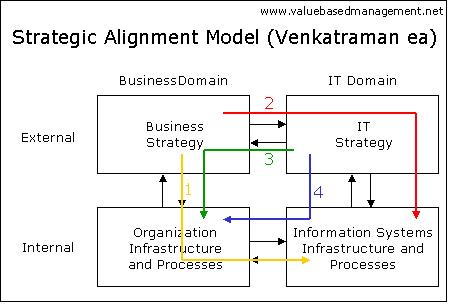
But this is not a new thought, much of my thinking around this topic is summed up in this diagram that dates back to 1993.

Here is the quoted text that explains it (click here for full text):

Venkatraman ea argue in 1993 that the difficulty to realize value from IT investments is firstly due to the lack of alignment between the business and IT strategy of the organizations that are making investments, and secondly due to the lack of a dynamic administrative process to ensure continuous alignment between the business and IT domains.

They describe Four Dominant Alignment Perspectives towards the analytic alignment of Business and IT:

  1. Strategy Execution: this perspective views the business strategy as the driver of both organization design choices and the logic of IS infrastructure (the classic, hierarchical view of strategic management). Top Management is strategy formulator, IS Management is strategy implementer. [Arrow 1]

  2. Technology Potential: this perspective also views the business strategy as the driver, however involves the articulation of an IT strategy to support the chosen business strategy and the corresponding specification of the required IS infrastructure and processes. The top management should provide the technology vision to articulate the logic and choices pertaining to IT strategy that would best support the chosen business strategy, while the role of the IS manager should be that of the technology architect - who efficiently and effectively designs and implements the required IS infrastructure that is consistent with the external component of IT strategy (scope, competences and governance). [Arrow 2]

  3. Competitive Potential: this alignment perspective is concerned with the exploitation of emerging IT capabilities to impact new products and services (i.e., business scope), influence the key attributes of strategy (distinctive competences), as well as develop new forms of relationships (i.e. business governance). Unlike the two previous perspectives that considered business strategy as given (or a constraint for organizational transformation), this perspective allows the modification of business strategy via emerging IT capabilities. The specific role of the top management to make this perspective succeed is that of the business visionary, who articulates how the emerging IT competences and functionality as well as changing governance patterns in the IT marketplace would impact the business strategy. The role of the IS manager, in contrast, is one of the catalyst, who identifies and interprets the trends in the IT environment to assist the business managers to understand the potential opportunities and threats from an IT perspective. [Arrow 3]

  4. Service Level: This alignment perspective focuses on how to build world class IT/IS organization within an organization. In this perspective, the role of business strategy is indirect. This perspective is often viewed as necessary (but not sufficient) to ensure the effective use of IT resources and be responsive to the growing and fast-changing demands of the end-user population. The specific role of the top management to make this perspective succeed is that of the prioritizer, who articulates how best to allocate the scarce resources both within the organization as well as in the IT marketplace (in terms of joint ventures, licensing, minority equity investments, etc.). The role of the IS manager, in contrast, is one of business leadership, with the specific tasks of making the internai business succeed within the operating guidelines from the top management. [Arrow 4]

The idea is to think through where a technology strategy or project starts to how it is implemented. Does it start with a tool, then you look how to leverage it? Does it start with a business or technology need? Or is it tied to the overall strategy? I think each of these has there place, there are times where technology should drive the strategy or where technology should be asked to solve a single problem. BUT that should be balanced by allowing technology to participate in the mission strategy as well.

I blame the CEO. Oops did I say that outloud? If technology is not integrated into your mission and mission team, I blame the CEO. The CEO does not have to be involved in, completely understand or even totally support technology. But the CEO is ultimately responsible for three things: appointing correct IT leadership, giving needed authority to IT staff and providing a reasonable budget. Notice I didn’t say they have to love technology, nor do they need to have cutting edge tools or whatever…

Before I continue my rampage, watch this slideshow about the role of CEO and CIO. This slideshow was the end result of years of work of the IT Director and CEO building a relationship.

I hope the positive approach in that slideshow was better than my short attack paragraph on CEOs, which really wasn’t meant as an attack at all. I have met many CEOs that I like.

The point here is that the IT department can do everything in their power to help meet the mission but until they are aligned within the organization it wont be as effective.

If you enjoyed this, good, because there are 10 more posts coming about the remaining chapters in the book called Managing Technology to meet your Mission. NTEN is also running an AWESOME 2 day online conference! Sign up today.