Showing posts with label italign. Show all posts

Monday, March 4, 2013

Technology Strategy Follow up to #MMM Episode 2

So last week I posted a one minute video on creating a technology strategy.

I showed the basic steps of:

  1. Listing your technology needs, projects and hopes in a spreadsheet
  2. Add columns for Effort, Priority and Cost
  3. Fill in columns with high, medium and low
  4. Then look for the combination of effort, priority and cost that you are able to accomplish
Well your technology plan really can be that simple when you are just beginning. When your needs are centered around your infrastructure it is easy to manage. When these projects start to cross over into enterprise software, websites, social media or communications, it can get much more complicated.

Creating a technology plan that requires process or cultural changes, is much more complex. These will take some deliberate steps to build support, prepare staff, enable champions, document your business, understand operational goals and so much more.

So why did I try to make technology planning look so simple?

Because if you don't start with your infrastructure, the other stuff is useless. If you have an awesome website with bandwidth too slow to upload images to it, optimal external communication tools but no good way to share information internally or you have the perfect enterprise software running on computers too slow to run it, then the best technology plan is just a waste.

So your technology plan ALWAYS needs to start with the basics. Get the trains running on time, keep the lights on, start with a foundation to build on or whatever metaphor you want to use.

Later I will look at how you should begin to add in concepts like organizational readiness, mission impact, return on investment, benefit analysis and all of the other ways to make your technology more meaningful.  You have to find purposeful ways to shift your technology from a cost center to manage to a transformative method to meet your mission.


Remember That Technology Is Not a Strategy
According to Allen Gunn, executive director of Aspiration, a San Francisco-based nonprofit technology consulting organization, many organizations make the error of treating technology as a replacement for strategy: “In the same way they’d order up pizza delivery, some nonprofits think they can order up a piping hot enterprise technology strategy. We tell organizations to take a step back and think about your business processes first. Look at things from a process-centric way and not a tech-centric way.”

Be sure to go read the full article, it is fantastic. 

Monday, January 28, 2013

Technology Impact #MMM Episode 1

I have been pushing myself to do more with video, but well it takes time to plan, create, edit, post, share, etc.

One Minute Movie on the last Monday of the Month. #MMM. Yeah. I think I can do that!

Then once I have a few similar ones, then maybe I can compile into a blockbuster.

Anyway. The first episode of #MMM = Monday Minute Movie Episode 1 is Technology Impact.


Then to learn more about the IT Alignment model referenced in the video visit my new IT Alignment page.

Tuesday, September 6, 2011

Silo Situation- Life gets in the Way part 6

"...allowed their culture to dictate their obsolescence." says Peter Campbell in his post about the Silo Situation.

It reads like a preview for a Hollywood script written by John Grisham starring John Cusak. It all seemed simple enough, the organization had the right hopes, the right mission and the right people but somewhere along the way they "...allowed their culture to dictate their obsolescence." This is the story of the one man who witnessed the whole bizarre series of events....

I have worked in a couple organizations where this Silo Situation was rampant. Each department, each team was so self sufficient that you would have no idea they were all one organization. But they were each successful and funding was flowing. So why question success? Why question what is working?

The silos were created because a grant was funding the program, so the team worked in an isolated group. Or this was a pilot program and needed to be secluded in case it didnt work. Or staff performance is only reviewed based on individual and department success. Or culture encouraged hoarding of information to gain power. Or leadership played favorites and kept secrets. There are so many reasons silos start.

We rest on our current and past success which clouds our ability to see the "silo situation." At the organizations I worked at you could always hear whispers about how bad the silos were.  But no one was willing to speak up, because those that did had faded off into the sunset. Suddenly though a big change happened, a funding problem, a crisis, change in leadership or whatever. Then one day we are all wearing buttons that say "silo busters." The org is buzzing with rhetoric and focus groups to destroy the silos. But don't we store all of our grain in silos? (sorry couldn't resist the random comment, just seeing if you are still reading)

When will we learn that collaboration is not new and is not a buzz word? Please don't let life get in the way of finding the silos in your org.

And oh yeah, go read Peter Campbell's AWESOME post!  (this time I will remember the link... sorry Peter)

Wednesday, June 8, 2011

Forget the Tech - Life Gets in the Way part 3

In our last post our heroes were too distracted with fighting fires and "she can't give much more, I'm an accidental techie not a miracle worker," were themes.

This time we find our heroes have finally built a stable infrastructure of technology and are now looking to have a real impact, not just be effective. We are looking to meet our mission.

WOOHHH, hold on there little horsey before I buck you right off. How can we jump right to the mission like that? Well actually if you don't have the mission as your goal, how do you know you will get there? And why bother doing something if it doesn't lead to meeting your mission.

Yes, there is a lot of technology that is just there to help us work and doesn't directly impact our mission. Well here is my thought about that. If technology doesn't tie directly to your mission, let someone else manage it. John Merritt likes to call that non-mission impact technology your commodity technology.

Why should you spend any of your time coming up with strategies and plans on your commodity technology when that just distracts you from doing these awesome steps below that transforms your technology into an ART that helps you meet your mission?

Below is an excerpt from an amazing blog post from John Merritt on his blog, be sure to visit and read the whole thing.

Matching Tech to Mission ~ Read and Understand the Strategic Plan

Knowledge is power and one of the best places to seek knowledge about your organization is by reading the strategic plan. Techies often feel the strain of being "misunderstood"; I would challenge each and every nonprofit technologist to begin by first understanding their organization.

It's All About the Relationship ~ Getting Connected Even if You're Not Wanted

How do you build a lasting and functional relationship with your organization even when you're rejected by the very people you struggle to support? You keep trying and you change your approach to meet each situation.

What does a Strong Relationship Between Tech and Staff Look Like? ~ Metrics

So, you've done your homework, read the strategic plan and your questions and relationship building have begun to bear fruit. What, then, does the tech/mission aligned organization look like? Have you really attained higher function? Here are a few examples in support of alignment and tech working in partnership with staff.

The Organizational Chart ~ Look for Obstacles

The way in which mission focused technology comes to be is largely based on the organizational chart, that funny diagram made up of boxes and lines that either puts tech on the path to success or the highway to, well...

Conclusion

"Forget the Tech, Let's Talk Mission" is about using the information and resources readily available in each of our orgs to develop questions and talking points to move technology closer to supporting the mission. Using available information and resources -- strategic plans, org charts and staff knowledge -- what questions can you ask that will bring better mission support and extension via technology?

Monday, July 19, 2010

NTEN Tech Leadership Academy and what I learned already.

While I have been working on my transition from Steve Heye to just "the Steve," I have been too busy to post to my blog.  So instead I am just going to share some of the things I have learned while preparing for the upcoming Tech Leadership Academy from NTEN. I'm presenting with John Merritt, but I have already learned a few things without the event even happening yet, just imagine once it does happen.


Incredible training op from NTEN - Technology Leadership Academy! This is a free training for smaller orgs, but it is so much more than just a training.  They have assembled some of the best trainers, well plus me, to cover the spectrum of technology topics.

Apply before July 30 right here! http://www.nten.org/techacademy

Part of what they will be covering in the Academy above is a great diagram that is in a slideshow from the awesome Holly Ross . The slide shows an adapted, simplified version of the IT Alignment stages that I refer to a lot. But they have added some arrows indicating that as alignment increases the technology brings additional service to the mission.  I like the simplicity of it.


But then she also a second diagram (but it looks like she is borrowing it from Save the Children) of a IT Strategy pyramid that talks about how to progress forward in these IT Alignment stages. This diagram helps illustrate that only one of the levels is solely focused on tech tools, the foundation.

The second level requires examining your operations and tech. The third level is not just business steps, it is how you deliver your programs, serve your constituents, meet your mission with tech.

The top of the triangle is all about what you do differently, this requires not just thinking about how you deliver services, but how you can leverage technology to completely change your whole organization, add a new service or completely redefine the way you meet your mission leveraging technology.

To see the full presentation that Holly created you can visit SlideShare at: http://www.slideshare.net/nten_hross/let-a-thousand-tech-flowers-bloom

Thanks for inviting me to participate Holly, looking forward to it!

Wednesday, June 23, 2010

IT Manifesto and Collection of things...

Holly Ross posted "A Leadership Manifesto: Let a Thousand Flowers Bloom" on the NTEN blog. Please take a minute to go to this post and make your comment, especially if you have a different viewpoint. This is a great post.  Here are a couple quotes that I cant help but share.

"Right now, in our sector, we need technology leaders.  We are standing right on top of a critical inflection point, and we owe it to our causes to make sure that we navigate the change as best as we possibly can. So I am calling on all of you to stand up and lead.  We will follow you."

"The old style of IT management was a command-and-control model.  It was about "experts" making decisions for the end users and mandating those decisions. These days, there are more experts than you think. innovation and expertise in technology can come from any staffer in any role, and technology leaders need to recognize and embrace that.  We need to run IT shops that protect our assets while encouraging this innovation. When everyone's a part of process, the revolution happens much more quickly."

And from out of the comments from Holly:
"tech is definitely undefined and muddy now. It's out of the back room and out in every department at your organization. Think about how we used to deal with IT...."  "now technology is a completely different beast. It's about communicating, conversing, collecting, sharing, advocating and more. It's about all the ways that we meet your missions."

Holly hints that the conversation about technology leaders has only just begun for the next year.  I cant wait to see what comes out of this.

And here are a few other gems I want to share:
Recording of a presentation on IT Alignment that John Merritt and I did for NTEN. It is worth a watch, we were on something of a roll that day.

Slideshow of Let a Thousand Flowers Bloom from Holly Ross.

Forget the Tech, Lets Talk Mission - Great article from John Merritt (he wrote it and just added my name)

And now for something completely different, be sure to take time to order your copy of Beth Kanter and Allison Fine's new book the Networked Nonprofit. Read more about the book and the launch!

Flickr Photo credit: Chris.Corwin

Monday, April 19, 2010

My more formal notes from #10ntc

#10ntc is the 2010 Nonprofit Technology Conference hosted by NTEN. These are my short, more formal notes.  This in no way covers the new people that I met, old friends I connected with, vendors I discovered, laughs I had and doesnt do justice to the Awesome-Sauce that the NTEN community is.  Maybe that will be my next post.


Summary of YMCA Day - April 8

Group of about 10 YMCA staff gathered and did a round robin of sharing projects they are working on.  The range of projects was from Sharepoint and websites to underwater pool safety cameras and video conferencing.  The group was excited to share and connect with other YMCA staff responsible for technology.

My biggest learning from the YMCA day was that we need to find a better way to stay connected with what other YMCAs are working on in order to not duplicate efforts and share learnings. Also that there is some sense of wanting to share tools and resources across tech staff but they meet resistance from leadership back at their centers.

There was a lot of mentions of YMCAs growing their use of Sharepoint as an intranet, document management and communication tool. However one of the more interesting side notes about intranets and websites was a debate/conversation about who owns it (Marketing, IT, Finance, Operations or ?).  YMCAs also seem to still be facing some of the struggles of centralizing IT and mixing it with operations as they grow and add centers.

Overall NTEN conference summary - April 9-10

The conference did not have a central theme, but if I had to pick one for what I learned it would be "rethink what drives your strategy."  

Your online engagement strategy should be 90% story, 10% technology. Find your audiences and adapt to where they are. GEORGE WEINER, Do Something <@georgecaweiner>

Our social media policy in 140 characters: Be transparent. Be responsible. Be Non-Partisan. Be Trained. Be Responsive. TAMMY GORDON, AARP <@AARP>

People don’t hate change. They hate disruption. PETER CAMPBELL, Techcafeteria <@peterscampbell>

For example one of the keynotes, Andrew Sullivan, suggested that people connect with another person online, not an organization or company. So your communications and web approach should walk the line of official org messages versus messages from individuals from within the org.  So this would make you question what drives your communication strategy to leverage those personalities within your org.

Another example is more specifically in the website strategy.  In order to have a full online presence strategy you need to include a large group of people.  Like Marketing for messages, IT for tools, program staff for content, operations for process, fundraising for philanthropy, and so on. But the key here is to change what drives the meetings, spend time talking about what we want to accomplish, what we want our audiences to do and what our audiences are interested in at the big group meetings.  Then let the decision makers that have been given the authority make it happen (IT, Marketing, etc). But those roles and that web strategy planning process has the be clearly defined so that while big and inclusive it still allows room for things to move fast and well.

Another example is around how we tell our stories of impact.  Right now we simply state that an event happened, maybe tell an anecdote and some stats, but it isnt a story.  If we want to change our stories to get people to act, then we need to rethink how and why we write stories. A story needs background, a conflict with resolution, a heartfelt connection and an easy to grasp message that ends with a call to action. We dont have a culture that creates and shares full stories, we focus on the outcome and miss the struggle and end with call to action. We need to change why we write stories and provide a better structure to those who are expected to write them.

General Conference thoughts

Combined Communications strategy - Lots of talk about social media, social networking, web 2.0 and sooo many tools, but the theme this year was to have a strategy that drives it all. Stop picking a tool then a strategy for that tool, rather have a central plan for what you want to say, who you want to converse with, what you want to hear and what you want people to do.  The tools like Facebook, MySpace, etc will keep changing, so set the strategy not the tool.

More interaction with audience - stop talking to people and have conversations with them. Heard this in social media sessions, website strategy and communications areas. People dont want to be talked to from an org. They want to have a conversation with a person.

New ways to educate audience - games, mobile devices, e-learning and more ideas are coming up that arent broadcast methods, rather they are ways to interact with a purpose.


Session notes:

Create a Culture of Storytelling 
(1 set of slides at http://www.slideshare.net/Loudmind/creating-a-culture-of-storytelling)
Stories have to come from your heart before they will go to people's heads. Dont tell stories that you arent so excited about that you run home to tell friends & family about it. Storytelling is weaved throughout ALL messages, pages and sites. Stories don’t belong solely on about us area. We need a writer on staff to drive this process and culture! It is good, actually encouraged to repeat a point across stories, can take 7 plus times before somebody remembers something. Seize opportunities–when feedback is asked for on another site about your cause, push your supporters to go and give it! Social media for non profits is just as much about listening as it is about sharing your mission.  Pick the words you want to use or not use! Are they victims or survivors (as an example). 
Making it Real: Getting Project Management Right for Content Management Web Projects
A central website strategy tied to a communications plan is needed for a successful website implementation and CMS project. A clear owner of the website strategy is needed, but has to be supported by a full representation of the organization. Stressed importance of content gathering to start early in the process to enable a better site map and navigation. Group debated whether to start or end with web design. On one hand people love to see the graphics and the visuals but on the other we loose sight of the message when focusing on details of design.  The purpose of the website should drive design in the end, but people clamour to see the structure. So providing early and frequent glimpses through sitemaps and wireframes are critical so people can see what you are talking about. They walked through steps of I was hoping to get more project management tips from this session, but it went offtrack and got too simple.

Secrets of Landing Page Testing: How to Optimize PPC to Convert More Donors, Activists, and Email Subscribers 
Really focused on use of combination Google Optimizer and Analytics to test the effectiveness of your website efforts and conversions. Landing pages are becoming even more important because search results and web campaigns aren't taking you to home pages any longer. Discussed how to do some A-B testing and how to evaluate the results.
Forget the Tech, Lets Talk Mission (IT Alignment materials Click HERE)
I presented this session with John Merritt from the San Diego YMCA.  Two organizations provided us sample strategic plans and supporting information.  We did several group exercises to try to demonstrate some tactical and strategic ways to move IT from being reactive to working toward the mission. It was great to be able to talk through some of challenges and objections people face, then work through ideas to make a difference.

Social Media's Potential for Faith Based Communities
I also presented at this session. It was interesting to debate through how allowing people to connect personally to church leaders may cause challenges of separation between leaders and members. The debate really brought to light the need for a purposeful discussion around the organizations versus individual voices. We also really highlighted the opportunities in social media for education around delicate or private topics. E-learning and resources are more readily shared in today's social media structure.

Friday, April 9, 2010

When Tech takes over! Beware.

I am at the nonprofit technology conference in Atlanta hosted by NTEN, it is my annual dose of information and inspiration to refill the my NPTech well. Last night I did an ignite presentation and had a lot of fun. (Ignite is 20 slides, 15 seconds each and you just have to keep up with the auto slide).

I did this mostly for fun, but ended up having one of those moments where something just becomes so clear that it shocks you a little. The point was to watch out how we talk about technology, because what we say isnt what people hear.

Stop involving and informing your stakeholders in technology, rather you should be involved and informed with them.

Dont try to get people on the side of technology. You should be on their side and have a strong enough relationship with your organization so that the technology becomes almost invisible and everyone sees the mission value of it.

Anyway,here is that video, enjoy. (sorry if the quality is weird, filmed on a flip).

Thursday, October 1, 2009

IT/Fin Dev Relationship, ONTC slides, NTEN guest blog

I have been pretty busy at work and at home but found a smidgen of time to do a few little things to possible help the greater good or inspire some thoughts.  So I thought I would share those here, in case both of my readers were interested.

First, John Merritt and I had a great time presenting during the Online Nonprofit Technology Conference for NTEN. We broke down our thoughts about how to approach IT Alignment based on a typical org chart.  After all an org chart does tell you a lot about how IT is viewed in your org. As we went through the slides we took turns sharing examples of how we approached each part of the org, plus highlighted successes and failures in those efforts.  Thanks to the awesome staff at NTEN for including us!  So here is that presentation:

But that's not all folks.

NTEN Blog Guest Post!

I was also invited to write a guest post for the NTEN blog, how cool is that!?!? They gave me free reign on topic but set a word limit.  Lucky for them I was a little focused that day and didnt end up talking about flying monkeys improve air quality or how lightsabres are awesome hedge clippers. Rather I stayed on topic and talked about IT Alignment, but I did completely ignore their suggested word limit!  CLICK HERE TO READ THIS AMAZING POST! (ok over did it there)

IT Guy to Fundraisers: Partner With Us


I was asked by Fundraising Success to write an article based on my planned participation in the ONTC.  So I decided to have a little fun with the friendly people over in Financial Development.  They can be so serious about raising all that money and stuff. Well anyway, you can read that article by clicking here, no maybe here, no wait here.


I will get back to the 11 part series next week, but at this rate I wont even finish this year.

Thursday, September 24, 2009

IT is not your friend and you are not our customer! =IT planning? (Part 4 of 11 on Managing Tech 2 Meet Mission)

(NOTE: please read the comments after the post, Peter has made some amazing observations and comments. As I thought, Peter is the master of this topic. Thx for the comments Peter, I should have had you just be a guest blogger. And now back to the original post.)

The goal of the IT department is not to make friends. Nor is it a good idea to follow the old thinking that staff in your organization are your customers. IT should act as a partner.

Whoa, slow down Steve, what does that have to do with the IT Planning and Prioritizing chapter by the brainiac Peter S. Campbell in the NTEN book, Managing Technology to Meet your Mission? Well, if you would be more patient, I will get there. I was trying to think what I could add to Peter’s chapter without just repeating his totally accurate and well thought out methodology. Because I cant compete with his knowledge on this topic.

However, I think an element that should be stressed when Peter talks about building that integrated plan that includes technology, is understanding how IT is seen by the org. We can write the best plans, set goals, define metrics and have all the best intentions, but if IT doesn’t have the relationships it needs they wont be acted on.

If you think of the staff in your organization as customers, then your ultimate goal would be to meet their needs working with the motto that the customer is right. In this approach you react to the requests and needs of your customers. Your role is to provide the solution, support or training that they tell you they need.


If you strive to have the friendliest, well liked relationship with the staff, then all you do is strive to make them happy. But sometimes we have to push back on some ideas in order to balance the needs of the full organization. We simply cannot make everyone happy all the time and be their BFF.


We have to act as a partner, we are all working toward the same mission. The relationship between IT can be a friendly one, but our allegiance should lie with the mission and strategic plan. As a partner we work with the other departments, not for them as customer implies.

So tying this all back to Peters “spot on” description about IT priorities and planning. Our ability to participate in the planning process and get invited to the table with access to provide input depends on the role we play. If we are simply taking orders, then the IT priorities will be subject to whimsical changes. If we are there to be their friends, will they heed our advice and expertise?

After saying all of that though, you would be mistaken in not reading Peter’s chapter and implementing the process he recommends. You may just want to be sure you keep the whole picture in mind and read the rest of the book too. The best laid plans….


Over 11 weeks I am doing a themed series of blog posts. Each week I will write about a chapter of the book called Managing Technology to meet your Mission. This week is on the 4th chapter about IT Planning and Prioritizing. You should totally buy the book. (In case you are wondering, I am volunteering to do this, I am not getting paid or in any other way reimbursed for this. I just love NTEN and their events.)


Flickr photos by kalandrakas and by Claudio Cicali and by LollyKnit

Thursday, August 6, 2009

Aligning Tech with Mission (Part 1 of 11 on Managing Tech 2 Meet Mission)

Meeting the mission is why we are here right? Then why not let everyone within your organization work toward meeting the mission, rather than just making things work?

That may be over simplifying things, but hey I am writing this blog post so if you don’t like it write your own or leave a comment.

Over the next 11 weeks I am doing a themed series of blog posts. Each week I will write about a chapter of the book called Managing Technology to meet your Mission. This week is on the 1st chapter about IT alignment (which I was the ring leader for). But rather than rehash what is in the chapter, I am adding a few things to it that compliment it very well. I want to talk about the role of the CEO and technology strategy. NTEN is also running an AWESOME 2 day online conference!

Lets start with Technology Strategy and how it gets created at a YMCA (you can adapt this to your org if you aren’t a YMCA). But rather than bore you with more words, flip through this presentation.

Key Thought:

Is your IT department there to just fill orders or is it a part of your mission team?

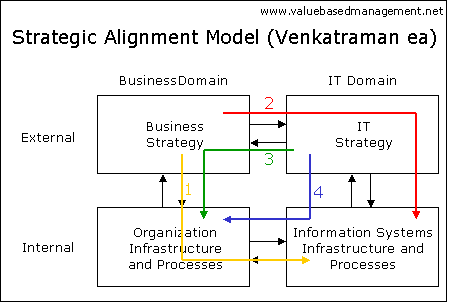
But this is not a new thought, much of my thinking around this topic is summed up in this diagram that dates back to 1993.

Here is the quoted text that explains it (click here for full text):

Venkatraman ea argue in 1993 that the difficulty to realize value from IT investments is firstly due to the lack of alignment between the business and IT strategy of the organizations that are making investments, and secondly due to the lack of a dynamic administrative process to ensure continuous alignment between the business and IT domains.

They describe Four Dominant Alignment Perspectives towards the analytic alignment of Business and IT:

  1. Strategy Execution: this perspective views the business strategy as the driver of both organization design choices and the logic of IS infrastructure (the classic, hierarchical view of strategic management). Top Management is strategy formulator, IS Management is strategy implementer. [Arrow 1]

  2. Technology Potential: this perspective also views the business strategy as the driver, however involves the articulation of an IT strategy to support the chosen business strategy and the corresponding specification of the required IS infrastructure and processes. The top management should provide the technology vision to articulate the logic and choices pertaining to IT strategy that would best support the chosen business strategy, while the role of the IS manager should be that of the technology architect - who efficiently and effectively designs and implements the required IS infrastructure that is consistent with the external component of IT strategy (scope, competences and governance). [Arrow 2]

  3. Competitive Potential: this alignment perspective is concerned with the exploitation of emerging IT capabilities to impact new products and services (i.e., business scope), influence the key attributes of strategy (distinctive competences), as well as develop new forms of relationships (i.e. business governance). Unlike the two previous perspectives that considered business strategy as given (or a constraint for organizational transformation), this perspective allows the modification of business strategy via emerging IT capabilities. The specific role of the top management to make this perspective succeed is that of the business visionary, who articulates how the emerging IT competences and functionality as well as changing governance patterns in the IT marketplace would impact the business strategy. The role of the IS manager, in contrast, is one of the catalyst, who identifies and interprets the trends in the IT environment to assist the business managers to understand the potential opportunities and threats from an IT perspective. [Arrow 3]

  4. Service Level: This alignment perspective focuses on how to build world class IT/IS organization within an organization. In this perspective, the role of business strategy is indirect. This perspective is often viewed as necessary (but not sufficient) to ensure the effective use of IT resources and be responsive to the growing and fast-changing demands of the end-user population. The specific role of the top management to make this perspective succeed is that of the prioritizer, who articulates how best to allocate the scarce resources both within the organization as well as in the IT marketplace (in terms of joint ventures, licensing, minority equity investments, etc.). The role of the IS manager, in contrast, is one of business leadership, with the specific tasks of making the internai business succeed within the operating guidelines from the top management. [Arrow 4]

The idea is to think through where a technology strategy or project starts to how it is implemented. Does it start with a tool, then you look how to leverage it? Does it start with a business or technology need? Or is it tied to the overall strategy? I think each of these has there place, there are times where technology should drive the strategy or where technology should be asked to solve a single problem. BUT that should be balanced by allowing technology to participate in the mission strategy as well.

I blame the CEO. Oops did I say that outloud? If technology is not integrated into your mission and mission team, I blame the CEO. The CEO does not have to be involved in, completely understand or even totally support technology. But the CEO is ultimately responsible for three things: appointing correct IT leadership, giving needed authority to IT staff and providing a reasonable budget. Notice I didn’t say they have to love technology, nor do they need to have cutting edge tools or whatever…

Before I continue my rampage, watch this slideshow about the role of CEO and CIO. This slideshow was the end result of years of work of the IT Director and CEO building a relationship.

I hope the positive approach in that slideshow was better than my short attack paragraph on CEOs, which really wasn’t meant as an attack at all. I have met many CEOs that I like.

The point here is that the IT department can do everything in their power to help meet the mission but until they are aligned within the organization it wont be as effective.

If you enjoyed this, good, because there are 10 more posts coming about the remaining chapters in the book called Managing Technology to meet your Mission. NTEN is also running an AWESOME 2 day online conference! Sign up today.

Thursday, July 23, 2009

Zoo or Jungle? what is your IT alignment?


When you go to the Zoo each of the animals has their area to live in. The zookeepers do everything they can to replicate the animals natural environment, diet and activity in their cages. They provide the best care that they can to keep the animal healthy and happy. The zoo keeper is focused on one exhibit or area at a time. However very few, if any, of the actions that the Zoo Keepers make for each animal actually help the full zoo. You treat each of the animal areas as individual projects.

In the jungle the ecosystem is what keeps it all running. It is no longer enough to only look at the needs of individual animal. Every decision and action has to be weighed against the overall shift in the ecosystem.

When we allow our organizations to grow into silos and then implement the technology solutions for each individual area are we just tending a zoo? So while that technology may help that individual, what did it do for the org or for the full mission?

My boss, Judith Sol Dyess, just posted some similar thoughts about how she just "deleted her strategy" on her blog. I find it very interesting that without strong IT leadership, further exaggearted with a big disconnect between IT and Leadership that the Zoo silos grow. Here is a quote from Judith:

"...one thing stands out. We have moved from projects that benefit the entire org, to department-based work. That’s not to say that Finance or Marketing don’t have valid technology needs, not at all. But this segregation of projects is troubling."

IT Alignment is all about matching your technology strategy to your organizations mission. Too often we get stuck tending the monkeys and loose track of the jungle we are in.

(zoo photo from Flickr mag3737)

Friday, May 1, 2009

People are more important than tools - #09NTC wrap up

The 2009 Nonprofit Technology Conference hosted by NTEN was an amazing experience. This was my 6th year and was by far the best. Here are some highlights to convince how crazy you are for having missed it.

First, Holly Ross, who I deeply admire for her ability to act as the gentle hand that conducts the symphony that is NTEN. Hollyonce stepped up and fullfilled her promise to reinact "All the Single Ladies". YOU HAVE TO WATCH THE VIDEO! In my opinion, Holly's smile, adorable daughter and genuineness make her better than Beyonce anyday!

People! It was awesome to have 1,450 people there to learn all about Nonprofit Tech! I felt so inspired and part of a real community. Our hashtag #09NTC was lit up all over twitter, we were only second behind the stupid Swine flu, cough cough, uh oh. Here is a great analysis of our traffic on Twitter via the #09NTC hashtag.

Clay Shirky was fantastic, the room was a buzz with quotes, thoughts and everyone pulling out their credit card to buy his book, Here Comes Everybody. I would take time to tell you what I learned, but this post with 15 Qutoes from Clay Shirky already did.

But here is one Shirky thought I would add these two:
  • Technology doesnt just allow you to do the same thing faster, it allows you to rethink how you do everything.
  • Use of social tools & application is more important than the design. so dont ask how to use socnet, ask why & what do you want 2 happen?
Eben Moglin, (learn more at http://en.wikipedia.org/wiki/Eben_Moglen) this talk was very intellectual and deep in thought. At times I was having a hard time keeping up because I was a little distracted with his slower presentation style. However, there were some real nuggets and deep insights to this talk:
  • Lets make knowledge something we share, not something that someone else owns.
  • Future is free software, free hardware and free bandwidth
  • "You can't stop people from thinking, you can only stop them from sharing"
  • Profit is not evil, but it is easy to do evil when your eye is on profit. Money isn't the problem, it's the love of money. Greed gets in the way.
  • Its not about intellectual property, it should be free speech
IT Alignment
I had the pleasure of presenting a session all about IT alignment with John Merritt from the San Diego YMCA, it was fantastic! We based the session on the IT alignment chapter from the NTEN book Managing Technology to Meet your Mission. But rather than cover what is already on the book, we went on a couple tangents, Role of the CEO and a conversation where IT Strategy comes from.


The role of the CEO presentation focused on what decisions the CEO has to make versus the IT Director. We also talked about John Merritt's favorite acronym, the ART of Technology. ART = Alignment, Relationship and Transparency. Align technology with mission, relationship between IT and all staff with a solid foundation of transparent technology (meaning it works so well you dont know its there).

We also stepped back in time t0 1993 to talk about this diagram from Venkatraman. This diagram demonstrates how many technology strategies get created. The key to this is understanding that there are many different ways that your IT initiatives will get started and your planning should include all of them.


Optimizing Landing Pages to convert more donors - Donordigital
Here are some ideas from the session (just some not all)
  • People read about 25% slower on the internet than on paper, so need less words
  • Things to test, headline, header image, gift strings, copy under headline and form layout.
  • Does your copy explain you mission, list how money will be used, is it tax deductible?
  • Are you asking for useless information on your donor form? like surname? middle initial, daytime number, suffix? I mean really are you going to use it?
  • Multivariate is testing multiple variables (page elements) on a landing page at the same time? How well do the elements work together?
  • Amnesty example talks about spending soo much of there times with interactive tools and widgets but they missed the point that people were getting lost at the landing pages because of content and layout. Traffic is only good if it stays and converts which was getting lost on widget focus.
Knowing where your constituents are online - Michael Cervino - Beaconfire
Steps to find online constituents:
  1. Outline key objectives of site and establish baseline
  2. Understand what to track - know what direction to go
  3. Understand cross channel performance
  4. Continually monitor trends
Other notes
  • You need to think through how to keep online donors, they are easy to loose and may have a tendency to not return. How will you engage and retain them?
  • Trends are more important than snapshots of activity
  • Target and communicate more with those that are most active. And downgrade those that are less active.
  • What is it that measures success for you on the web? What is your key outcome?
  • How do you find out who is already talking about you on a social space or a blog? and are they worth trying to recruit to speak on your behalf? and are they able to help? Google search with technorati can find top blogs using key words. www.issuecrawler.net is a good resource to find blogs on similar topc/interest.
  • Find methods to get people to talk about you, dont push messages, build relationships and arm your supporters with tools.
  • One of the greatest predictor in a fundraising event is your campaigners getting that first gift.

Unleashing the Ultimate Cool Factor: Case Studies of Conferences Energized Through Social Media - big panel with Maddie Grant

  • Talking about an event and building the hype should be a year round activity.
  • Build a community around the purpose of the event
  • Rally to build knowledge and sharing even before you get together in person
  • dont do anything in social media unless you have a goal and you can measure it
Effective Online Communications - John Kenyon (Awesome NPTech Rockstar)
  • build your online coummincation for your audience, not what your staff or board wants.
  • Create a calendar of communication plan, but think message not tool (who will write, what, when) then match tool 2 audience
  • Content, cultivation, credibility and clickability - 4 Cs of a
  • Volume of email subscriptions is not useful if they dont really want to hear from you.
  • Hilarious="if sister margaret can maintain a website at 87 and learn HTML at 74, then you can too."
  • Email should be personal, targeted, integrated with web/direct mail, trackable
  • good content=1. highlight keywords 2. use bullet list 3. one idea per pargph 4. cut txt in half twice 5. use links
No Country for old media - David Neff (American Cancer Society=ACS)
Click here to see the full presentation or here are a few highlights:
  • Help your supporters take the Lead – The frozen pea fund was a very successful fundraising campaign that was hatched by a Cancer survivor. She needed an ice pack in recovery, but didn’t have one, so she used frozen peas. Then decided to post that and share it and the concept caught on to a group. Then ACS heard about it, contacted them to provided support and tools.
  • ACS decided not to use YouTube because of possible negative & stupid comments, like "dude, that video sucked"
  • Everyone should be thinking about some sort of mobile giving campaign, use of mobile tech is exploding
  • google analytics, summize.com, compete.com, tweetscan.com, google blog alerts beta, viewzi.com facebook, good search tools to monitor conversations
  • ACS gave access to secret special videos if someone raises enough money for their org
Well anyway, it was an awesome conference, mad props to the staff at NTEN! Can't wait for Atlanta NTC, April 2010.

Wednesday, April 1, 2009

Top 10 ways that Richard Simmons is like Technology

So yesterday Richard Simmons was at Union Station in Chicago promoting Cranberry Juice and I was trying to plan in my head what I was going to say on the NTEN book release party (More on book here).  Desperate to be clever, I combined the two and thought, you know what, technology is just like Richard Simmons.  So in rememberance of that, I thought I would share the Top 10 ways is like Technology.

11. You cant stop talking about it, even if you want to.

10. It can seem so cool when it first comes out, but watch out when it gets old.

9. Fans can go a little overboard in their devotion to it.

8. Brands will sometimes take on their own life, so dont be afraid to make fun of yourself.

7. Sometimes the best functionality is hidden under the most interesting interface.

6. People cant stop watching it, but probably wont be running to join you on stage.

5. Adding flashy options like short shorts and tank tops doesnt change the core functionality.

4. You wait to say how much you like it until someone else does.

3. Experts come in all varities.

2. Hard to change an image or reputation once you have sold it.

1. You cant judge a book by its cover.

And yes, I know there were 11, it's the way I roll.  Hope you enjoyed this.  Back to work now. (photo from Flickr Interrobang)

Monday, March 23, 2009

IT Alignment just cant get an audience


Steve, no one cares, please stop talking about IT Alignment.  Unless it is cool like social media, sweet gadgets like the iPhone (which I hate, maybe cuz I dont have one), or innovative like (insert cool software name here), it just wont get the hype.

I think I finally figured out why. IT Alignment requires you to think about your full organization's strategy and the adapt your technology strategy to support it.  How many nonprofits really have a staff person that is able to do that, has the time, has the desire and also has the authority to act on it?  And even if you have that person, they probably have something that they consider sexier or more fun that they want to focus on. 

I mean seriously, who gets famous in the NPTech sector or anywhere for improving their technology strategy to better support the mission. NO ONE, is my guess.  They may get recognized or talked about if a portion of it was innovative, unique or green.

So knowing all of this, why do I even keep talking about it? Well, thanks for asking.  I believe that by first focusing on your technology strategy to build toward IT Alignment you are then able to be much more successful and purposeful in every way.  Not only will your technology strategy be stronger, your whole organization and mission will be impacted and enhanced.

If you think some of the technology work you are doing now is great, just imagine how much more successful it would be if the culture of your org shifted to embrace technology.  What if all areas of your organization were actively looking for opportunities to meet the mission and approached the IT department to talk about the need that should be met. Then you collaborated to explore the need to see if it fit with the mission and strategic plan.  Then spent time setting goals and metrics.  Then lastly searched for the appropriate solution.

That is vastly different than what I see as the normal way to interact with the IT Department. Usually people come with the solution in mind and look for approval from IT to buy it. The other is to manage your technology department as a cost center, look at how much is being spent compared to how much money you have, versus evaluating impact against budget.

Anyway, as you can see I am on something of rant.  I should drink more coffee before writing my blog post.

Monday, March 16, 2009

IT Alignment over the years, the story and history part 3


Jello. When you make jello you have to wonder, how will this ever come together and take shape? It seems like it is a liquid and wont ever solidify. But then right when you aren't watching it happens. One minute its liquid, free flowing and hard to contain, then next it takes on a new life in the form of the mold you chose. (Photo via andycarvin on Flickr)


That was how the IT Alignment diagram and spreadsheet happened. And there's always room for Jello, so take some time to read these posts and use the IT Alignment resources!

______________________________________________________


This series of posts is in honor of the newly released book from NTEN called Managing Technology to Meet your Mission. We are having a release party on March 31, its a free online party, so join us! And now for our regurlarly scheduled program:
_________________________________________________

So like our jello, our ideas were very liquid about what this drawing could be and what it should include.  (For those of you just joining us, we are trying to create a single picture that demonstrates how technology is integral to the mission, yeah right).  We had ideas of flow charts, images, data maps and still photos of fruit (ok maybe not the fruit.)

The group struggled for a few months on this image idea.   But then we remembered that Jello needed to be in a mold for it to have a shape and we got to pick that mold.   What would we want people to see and learn when they looked at our image.  We picked up on a couple key elements that had to quickly be portrayed.
  • IT Alignment is an ongoing process, not a single project or set of steps
  • There is no one right solution, method or set of goals - you have to find the right IT Alignment stage for you and your org
  • Dont focus on the technology - balance of people, process and tools is key
  • IT Staff has to be integrated into overall organization
From there picking the mold came quickly.  So I made a sample graph.
The group didnt really like it at all. Next mold please. That is when John Merritt from the San Diego YMCA jumped in and gave us a much clearer idea.


So I tried this:


These were better and the group liked them, but we still werent there. So that is when John Merritt stepped in again, having seen our previous attempts he created a great model and then we gave it to some professional graphic designers, which led us to our final product.  Once the image was done, we quickly created the IT Alignment  assesment spreadsheet based on it.  The words, scoring and other pieces of the spreadsheet were easy when we tied it all back to our image.  Plus we had an awesome team of YMCA staff helping review this and we were all very excited and learned something along the way.

The diagram and spreadsheet were distributed and the YMCAs that implemented and used them, loved it. They got their IT team together and used the resource, then shared it with the rest of their org.  Their leadership and boards were engagned, it started whole new coversations.

I would love to say that this resource exploded in popularity and got used heavily, but alas Fate had it own ideas.  New leadership, new strategic plan and new direction came to the national office at the YMCA of the USA.  And they asked the CEO's across the YMCAs what was most important to them.  And of course, the CEO's didnt rate technology as most important, probably because it isnt.  Technology isnt the priority, but every single thing that the CEOs said was important would require technology to give it the biggest benefit.  

But that is not how the YUSA leadership saw it.  They announced that technology was no longer a priority to help YMCAs with.  They said "IF the demand exists" for YMCAs to get help with technology that they would turn to a vendor.  So my department, this resource, the YMCA technology committee (Y-Tech) and the tech conferences were all closed in June 2008. All of the progress that started to grow was summarily dismissed.  While it seems that the acknowledgement and importance of technology is growing in other orgs based on the work from NTEN, our YMCA national office decided it was just a fad or something.  We dont need a central technology strategy, all we need is for each area of YUSA to have a little bit of info about the technology that pertains to their focus. FAIL.

My biggest mistake with all of this, I think, was that I was so focused on helping the local YMCAs understand IT Alignment that I forgot to make sure my own leadership at YUSA understood it enough.

But as I was given permission to share this resource with other orgs they saw the value immediately. So when the opportunity was posted to be an author for the NTEN book, I jumped on it and emailed Holly as fast as I could, of course that was after checking with the legal department at YUSA.

I have missed some details in this story, but I think you get the idea.  I also dont want to paint a picture that the YMCA or YUSA is messed up.  The YMCA as an organization is going through some very big and fundamental shifts.  The YMCA of the USA has set some lofty goals and created a vision for the future of our movement.  I COMPLETELY AGREE AND SUPPORT this mission focus that our YUSA leadership is bringing.  We need to get back to what makes the YMCA great, which is Spirit, Mind and Body, not just the body. And our national office is helping make that happen.  They are just missing out on the mission enhancing impact that technology can have.
_________________________________________________
I would love to take time to thank everyone that was involved in creating this resource, but there were just too many. They are all listed in the opening of the paper though.

The full resource, diagram and assesment spreadsheet are all available at: www.meetyourmission.org.

Also, John Merritt and I will be presenting a session on this at the upcoming, Nonprofit Technology Conference, be sure to come see us there.