A big hello to all of my blog readers! (all 3 of you)
I am excited about the attention Missional Technology Planning has been getting! Love it!
I even get to give the presentation here again in Chicago, you should come, everyone is invited:
https://www.eventbrite.com/e/501-tech-club-chicago-lunch-n-learn-tech-planning-smack-down-tickets-12209403655
But if you are one of my new blog readers or just haven't been paying attention, you might be thinking: What is the Missional Technology Planning Steve is writing about?
Well you are in luck! Here are two video interviews I did back at #13NTC with MAP for Nonprofits! So go grab your org's mission statement, the strategic plan and some popcorn and watch these!
NOTE! Please forgive my look of exhaustion and hat head. I think I should have left the cowboy hat on... These interviews were after a string of presentations and I had no idea what I looked like.
And now that you know what Missional Technology Planning is, Are you ready to use it?
Showing posts with label mission. Show all posts
Showing posts with label mission. Show all posts
Friday, July 11, 2014


Thursday, May 15, 2014
4 Easy Steps to Missional Tech Planning
This post is a follow up to a Tech Planning Smack Down: Behind The Scenes post on the Community IT blog about a Session at the Nonprofit Technology Conference. Be sure to go read that post first!
A silver bullet for technology planning does not exist. There is no right way to do it for everyone, your job is to find the way which works best for you today (might be different later). But it actually goes even further, you may have to use multiple technology planning methods to build a single plan. We will walk through Tactical, Strategic and Missional technology planning.
In order for technology to meet staff and organization needs, support the organization’s strategic plan and provide innovation for program delivery and mission impact, it will need to implemented in a range of ways. Each style of technology planning requires different information, people, time, resources and skills. Each of them is also used to create different plans over different periods of time. The first key is to have an overview of each type of planning; Tactical, Strategic and Missional.
Tactical: focuses on using quick timelines with small teams (even one person) to get all of the technology working correctly, establish a replacement plan with improvements and begin to address problems, not symptoms.

Strategic: Shifts to meeting the operational and strategic needs of the organization. Relies on cross-functional teams with a need for business process changes, staff training and change management. As strategic technology improves it gets tied to and even can be integrated into the organization’s strategic plan.

Missional: Scope shifts beyond the goals and plans to the mission and vision of the organization. This often requires expertise, insight and collaboration from outside the organization. Identify gaps between your ability to meet the mission and the capacity of the organization, then march technology to the gaps.

Just understanding the types isn’t enough though, you have to know how you create and implement the plan too. But the real trick is that there is no one right way to do the planning. Here are just some ideas, but you have to make it your own.
There are plenty of resources out there to show you how to do the tactical and strategic planning. I would suggest reviewing the Tactical Tech Planning course from Idealware, attending the Nonprofit Tech Academy from NTEN and reading the Unleasing Innovation paper from MAP Tech Works. You should also consider working with a consultant to run the process and bring in outside expertise.
But I have not found as many which focus on the mission focused technology. Which is why we ran a session on it at the 2014 Nonprofit Technology Conference. So here is our idea on how to do it. (Lindsay Bealko from Toolkit Consulting and Andrea Berry from Idealware were key in planning and running this)
Who: Pull together a diverse group of people from inside and outside of your org with a wide set of experiences and expertise (including some who may not know your org well, but understands the cause). Have this group break into small teams and the activity we did in our session.
1. Mission or Vision Statement
Review your mission and\or vision statement and look for the phrases or concepts which:
2. Identify the barriers
What stands in the way of acting on or in completing the selected part of your mission or vision statement? Create a list of these barriers.
3. Brainstorm with technology
Use a set of cards with different types of emerging and core technologies (prepare these cards ahead of time). These cards should have a range of things from e-learning, emails, websites, mobile apps, text messaging, tablets, computer labs, CRM, big data, wide area network, etc.
Have the group brainstorm possible technology approaches to each of the barriers you identified in the second step. To make it tougher we had the group pick the technology which seemed like the least likely match. Challenge the group to look for ideas which do not rely on staff intervention, extend past the reach of the org, have a direct impact on constituents, etc. Come up with your own rules for the group based on your style, culture and cause.
4. Bring it back
You may or may not come out of this exercise with a real and actionable idea to act on. But what you will get is a whole new conversation. Find a way to collect the info and then build on it.
Intro
A silver bullet for technology planning does not exist. There is no right way to do it for everyone, your job is to find the way which works best for you today (might be different later). But it actually goes even further, you may have to use multiple technology planning methods to build a single plan. We will walk through Tactical, Strategic and Missional technology planning.
In order for technology to meet staff and organization needs, support the organization’s strategic plan and provide innovation for program delivery and mission impact, it will need to implemented in a range of ways. Each style of technology planning requires different information, people, time, resources and skills. Each of them is also used to create different plans over different periods of time. The first key is to have an overview of each type of planning; Tactical, Strategic and Missional.
So first an overview of each type.
Tactical: focuses on using quick timelines with small teams (even one person) to get all of the technology working correctly, establish a replacement plan with improvements and begin to address problems, not symptoms.
Strategic: Shifts to meeting the operational and strategic needs of the organization. Relies on cross-functional teams with a need for business process changes, staff training and change management. As strategic technology improves it gets tied to and even can be integrated into the organization’s strategic plan.
Make It Happen
Just understanding the types isn’t enough though, you have to know how you create and implement the plan too. But the real trick is that there is no one right way to do the planning. Here are just some ideas, but you have to make it your own.
There are plenty of resources out there to show you how to do the tactical and strategic planning. I would suggest reviewing the Tactical Tech Planning course from Idealware, attending the Nonprofit Tech Academy from NTEN and reading the Unleasing Innovation paper from MAP Tech Works. You should also consider working with a consultant to run the process and bring in outside expertise.
But I have not found as many which focus on the mission focused technology. Which is why we ran a session on it at the 2014 Nonprofit Technology Conference. So here is our idea on how to do it. (Lindsay Bealko from Toolkit Consulting and Andrea Berry from Idealware were key in planning and running this)
Who: Pull together a diverse group of people from inside and outside of your org with a wide set of experiences and expertise (including some who may not know your org well, but understands the cause). Have this group break into small teams and the activity we did in our session.
1. Mission or Vision Statement
Review your mission and\or vision statement and look for the phrases or concepts which:
- extend for many years
- exceed the capacity of your org
- requires collaboration across the sector
- reflects the big hairy audacious goal of the org
2. Identify the barriers
What stands in the way of acting on or in completing the selected part of your mission or vision statement? Create a list of these barriers.
3. Brainstorm with technology
Use a set of cards with different types of emerging and core technologies (prepare these cards ahead of time). These cards should have a range of things from e-learning, emails, websites, mobile apps, text messaging, tablets, computer labs, CRM, big data, wide area network, etc.
Have the group brainstorm possible technology approaches to each of the barriers you identified in the second step. To make it tougher we had the group pick the technology which seemed like the least likely match. Challenge the group to look for ideas which do not rely on staff intervention, extend past the reach of the org, have a direct impact on constituents, etc. Come up with your own rules for the group based on your style, culture and cause.
4. Bring it back
You may or may not come out of this exercise with a real and actionable idea to act on. But what you will get is a whole new conversation. Find a way to collect the info and then build on it.
Presentation Slides:
Here are the slies from the presentation.Tuesday, January 14, 2014
Tech Planning Smack Down! Tactical vs. Strategic vs. Missional
I am preparing for a session I will be presenting at the 2014 Nonprofit Technology Conference. I have been having an internal battle for 15 years on the topic of Strategic Technology Planning. I have read books, blog posts, case studies and articles proclaiming the best practices of a Strategic Technology Plan. But as I often repeat, “Best for you, isn’t best for me. Let’s talk about Model Practices.”
This leads me to a topic I have seen bounding around recently. Maybe we don’t all need a strategic technology plan. At first, you have to focus on a stable infrastructure.
As a terrific example, Idealware has created their Tactical Technology Training, which I LOVE!
But we all know a strategic plan is needed for deeper impact of our technology. Which I would recommend the Tech Leadership Academy from NTEN.
However, the contender I want to bring to the ring is MISSION.
Sure our Strategic Technology Plan is tied to mission via a close tie to the organization’s overall Strategic Plan. But what about stepping back to find ways for technology to directly impact the mission, not to support the org in meeting the mission. Do you see the distinction?
Here are a couple slides to illustrate this, but I would love for a few people to watch the video embedded below and give me some real feedback. I will be refining the concept, slides and presentation between now and March 2014. This is just a sampling of what will be discussed there, but I could really use your feedback!


Tuesday, September 3, 2013
Go BIG or go home (is mission the price for BIG though?)
As a teen every summer I spent a week at a camp meant to build values and leadership. My first years we had about 60-75 people. You had the chance to meet everyone. It was a close knit group and there was no hiding. This small group of people changed my life. I fit in.
But leadership wanted bigger impact and more kids! They had big plans and the only way to get there was more money and more kids.
My first few years, we had to earn our way to camp. We had to complete volunteer hours, attend fundraisers and be active in our local club. But since we earned our way there, it meant so much more. We felt a sense of ownership in making the camp the best possible experience.
To get the bigger numbers quicker, you no longer had to earn your way. The hope was to get kids there, then show them the way. But the kids were not invested, they were there to have fun. Suddenly there were more problems, which led to more rules. This of course led to more kids trying to get around the rules. All sense of trust and responsibility was lost.
With the rapid growth also came crowd mentality over individual expression. With the increase in attendance came a shift of ownership, now the staff had to be in change, just to keep control. It was no longer our responsibility to have a good experience. The staff now had to entertain us and if isn't fun, the staff were blamed.
In my opinion, mission was the price we paid for growth.
I often wonder if this is a common challenge for nonprofit technology staff.
Do we look to increase efficiency, build capacity, innovate, help staff, and expand our organization through technology without considering the impact on our mission?
As technology staff are we connected enough to the mission to know the impact of our projects and plans?
Friday, December 30, 2011
Are we consuming missional? (Inspired by @daveferguson)
Has mission become a commodity? Has it become so transactional, overused, cliche and ommon place that it is just another thing to cross off of our list of to-do's?
I know the focus off my blog is usually tech, but hear me out. And yes, I am building off of a faith based post from my church's pastor, you can read it here: daveferguson.org: Are We Just Consuming "Missional"?
First, I love this thought: "1. Missionary As Identity - If we want the people in our churches to engage in mission we must make sure they understand that being a missionary is not something you consume, it is your identity."
We could all learn a lot from churches that inspire us to not just change what we believe but actually change who we are.
How often do we just work toward or on our mission rather than owning it by letting of become part of who we are? Haven't you ever met that person that just oozes mission? It is like it is who they are. People like @hardlynormal who lived homelessness, @starfocus that lives for wildlife and so many more.
I like to think that I am missionary in my Christian faith, plus the YMCA mission of healthy living, youth development and social responsibility. I like to think that I don't just find technology to help support and meet our mission, rather I find ways to allow our staff, volunteers and supporters to live the mission. I provide social media to allow their infectious spirit to spread. I work to shift our content on our website to not just promote our services and org, but rather to make the change happen in the people we serve. I look for technology solutions that allow our staff to live the mission rather than fight with tools. I push to have our technology goals tied directly to mission on top of supporting operations.
Yes Steve but you aren't telling us anything new. Well you are right, this isn't new. But it is easy to forget and loose sight of. Takes a few minutes to do a check to see if you are working on your mission or if you are living it.
As the new year starts, I am looking to become more missionary in my faith, work and family life. I don't want to take steps forward. I want to change who I am.
Friday, June 17, 2011
Mission Critical or Impact? - Life Gets in the Way part 3-a
I was going to move on to part 4, but decided I can make my own rules and decided to have a part 3-a. It's my blog so I can do what I want.
In the last post I talked about the role technology can play in meeting your mission. Since I posted it though I can't stop thinking about mission critical technology versus mission impact technology.
For years we have talked about the importance of planning for disaster recovery and business continuity on your mission critical systems. My definition of mission critical is a technology that dramatically impacts your ability to meet your mission. But I think the key to that phrase is "your ability". A mission critical technology changes the way you work or improves a process in such a way that it helps you meet your mission.
But when I talk about technology helping you meet your mission, I want to focus on mission impact technology. Meaning that you implement technology in such a way that it directly meets your mission, not just improves a process or assist you, it actually makes touches those you serve.
I think the distinction between a technology being mission critical and having mission impact is an important one.
An example within the YMCA is our membership databases could be considered mission critical. But our use of tools like ActivTrax to plan workouts, track nutrition and provide guidance directly impacts our members goals and our mission of healthy lifestyles.
Another example could be our website and email blasts as mission critical. But if we were to adapt those tools or social media to connect our members together in order for them to support and encourage each other on their fitness goals, it gets closer to mission impact.
It is not always clear cut, some technology can be both but only when used correctly.
There are other examples, what are yours?
Thursday, May 20, 2010
Software randomly creates policy where none exists & other stuff I learned
If there isnt a documented process, policies or set of standards that your organization uses to define it's best practices on how business is conducted, then by default your software may create it for you. Software and the solutions you use will have built in policies and processes. So in lieu of you picking the best way to run your business you allow the software to do it for you. WOW! How come I had never really put that thought together in my head?
Ok, so in many cases following the rules and policies dictated by your software is a good thing. Many times these are based on regulations, business practices and audit standards. But beyond that should you determine the most effective way to run your organization, then try to adapt those practices to your software. Rather than seeing how the software works, then letting that dictate your process?
Slow down Steve, where is all of this craziness coming from?
I was excited to be given the chance to present my #10ntc Ignite session for a small group over at the Great Book Foundation. My ignite session tries to relay a point about how technology staff talking about tools and solutions can kill your audience. After that I spend about 20 minutes talking all about IT Alignment stuff from the NTEN book. Then we opened it up for some questions and answers.
There was a group of questions that revolved around determining policy, planning technology strategy and staff roles in all of this. That is when someone asked about how do you manage a multi-layer technology strategy that meets the needs of the individual staff, each department and the full organization. If you are meeting all of those needs wouldnt that require multiple technology strategies and require those strategies to start from very different perspectives?
That lead me to try to explain how you do need to have a few parts to your IT Alignment strategy. This goes back to John Merritt's idea of the ART of the Technology. ART = Alignment, Relationship, Transparency. First, have a strategy to make the technology work so well that it is transparent, second work to build relationships between IT and the rest of the org, third move technology to meeting the mission through Alignment. So yes, it is a bunch of strategies, not just one focused on mission, but that is still the end goal.
Steve, you are so off track yet again, wasnt this post about software creating policy? Yes, it is about that and I am trying to get back to that if you would just let me.
This then loops us back to the comment about software creating policies and practices where there are none. If you dont have a well rounded technology strategy that is focusing on all three elements Alignment, Relationship and Transparency tied to the mission it is easy to let the tools take over.
WOW! Did you see how I just tied that all together and referenced the ignite session as well? ZOINKS!
Thursday, March 11, 2010
How to Write a Mission Statement That Doesn't Suck
This awesome video from Fast Company says a lot in just a few minutes. I know I could not have said it better.
And I dont think this just applies to our mission statements. I think you can use the ideas in this video to apply to a lot of the content, messaging and stories we write. How many times have you written something that you think is great, only to have it edited so much that you cant even remember why you wrote it.
We try to appeal to too many audiences, make sure all of our bases are covered. By covering all the bases, you are diluting the message.
Lets all try to be more concise and say what we mean, skip the buzz words and trying to say it all. Say what is important and end it.
Thursday, August 6, 2009
Aligning Tech with Mission (Part 1 of 11 on Managing Tech 2 Meet Mission)
Meeting the mission is why we are here right? Then why not let everyone within your organization work toward meeting the mission, rather than just making things work?
That may be over simplifying things, but hey I am writing this blog post so if you don’t like it write your own or leave a comment.
Over the next 11 weeks I am doing a themed series of blog posts. Each week I will write about a chapter of the book called Managing Technology to meet your Mission. This week is on the 1st chapter about IT alignment (which I was the ring leader for). But rather than rehash what is in the chapter, I am adding a few things to it that compliment it very well. I want to talk about the role of the CEO and technology strategy. NTEN is also running an AWESOME 2 day online conference!
Lets start with Technology Strategy and how it gets created at a YMCA (you can adapt this to your org if you aren’t a YMCA). But rather than bore you with more words, flip through this presentation.
Strategic Plan (where is tech?)
View more presentations from Steve Heye.
Key Thought:
Is your IT department there to just fill orders or is it a part of your mission team?
But this is not a new thought, much of my thinking around this topic is summed up in this diagram that dates back to 1993.
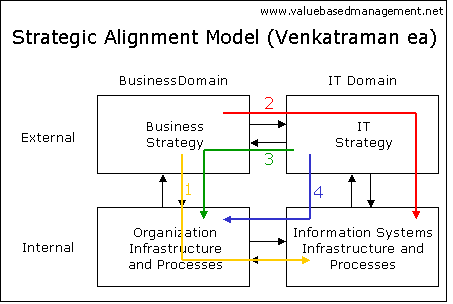
Here is the quoted text that explains it (click here for full text):
Venkatraman ea argue in 1993 that the difficulty to realize value from IT investments is firstly due to the lack of alignment between the business and IT strategy of the organizations that are making investments, and secondly due to the lack of a dynamic administrative process to ensure continuous alignment between the business and IT domains.
They describe Four Dominant Alignment Perspectives towards the analytic alignment of Business and IT:
-
Strategy Execution: this perspective views the business strategy as the driver of both organization design choices and the logic of IS infrastructure (the classic, hierarchical view of strategic management). Top Management is strategy formulator, IS Management is strategy implementer. [Arrow 1]
-
Technology Potential: this perspective also views the business strategy as the driver, however involves the articulation of an IT strategy to support the chosen business strategy and the corresponding specification of the required IS infrastructure and processes. The top management should provide the technology vision to articulate the logic and choices pertaining to IT strategy that would best support the chosen business strategy, while the role of the IS manager should be that of the technology architect - who efficiently and effectively designs and implements the required IS infrastructure that is consistent with the external component of IT strategy (scope, competences and governance). [Arrow 2]
-
Competitive Potential: this alignment perspective is concerned with the exploitation of emerging IT capabilities to impact new products and services (i.e., business scope), influence the key attributes of strategy (distinctive competences), as well as develop new forms of relationships (i.e. business governance). Unlike the two previous perspectives that considered business strategy as given (or a constraint for organizational transformation), this perspective allows the modification of business strategy via emerging IT capabilities. The specific role of the top management to make this perspective succeed is that of the business visionary, who articulates how the emerging IT competences and functionality as well as changing governance patterns in the IT marketplace would impact the business strategy. The role of the IS manager, in contrast, is one of the catalyst, who identifies and interprets the trends in the IT environment to assist the business managers to understand the potential opportunities and threats from an IT perspective. [Arrow 3]
-
Service Level: This alignment perspective focuses on how to build world class IT/IS organization within an organization. In this perspective, the role of business strategy is indirect. This perspective is often viewed as necessary (but not sufficient) to ensure the effective use of IT resources and be responsive to the growing and fast-changing demands of the end-user population. The specific role of the top management to make this perspective succeed is that of the prioritizer, who articulates how best to allocate the scarce resources both within the organization as well as in the IT marketplace (in terms of joint ventures, licensing, minority equity investments, etc.). The role of the IS manager, in contrast, is one of business leadership, with the specific tasks of making the internai business succeed within the operating guidelines from the top management. [Arrow 4]
The idea is to think through where a technology strategy or project starts to how it is implemented. Does it start with a tool, then you look how to leverage it? Does it start with a business or technology need? Or is it tied to the overall strategy? I think each of these has there place, there are times where technology should drive the strategy or where technology should be asked to solve a single problem. BUT that should be balanced by allowing technology to participate in the mission strategy as well.
I blame the CEO. Oops did I say that outloud? If technology is not integrated into your mission and mission team, I blame the CEO. The CEO does not have to be involved in, completely understand or even totally support technology. But the CEO is ultimately responsible for three things: appointing correct IT leadership, giving needed authority to IT staff and providing a reasonable budget. Notice I didn’t say they have to love technology, nor do they need to have cutting edge tools or whatever…
Before I continue my rampage, watch this slideshow about the role of CEO and CIO. This slideshow was the end result of years of work of the IT Director and CEO building a relationship.
The CEO, IT & Mission
View more presentations from Steve Heye.
I hope the positive approach in that slideshow was better than my short attack paragraph on CEOs, which really wasn’t meant as an attack at all. I have met many CEOs that I like.
The point here is that the IT department can do everything in their power to help meet the mission but until they are aligned within the organization it wont be as effective.
If you enjoyed this, good, because there are 10 more posts coming about the remaining chapters in the book called Managing Technology to meet your Mission. NTEN is also running an AWESOME 2 day online conference! Sign up today.
Wednesday, June 24, 2009
T-Shirts transform people to heros
 Each of you has been issued a t-shirt. You have to wear everyday it while you are working here for the next week. This t-shirt will give you an instant reputation and a free pass to many things. This t-shirt has been worn by many, many groups and individuals before you. The people here in New Orleans know and recognize the t-shirt and they know you are here to help. Wearing that t-shirt you can walk into a restaurant, use the bathroom and leave, and noone will question you. That t-shirt will allow you to walk down some of the most dangerous neighborhoods and people will be kind to you. That t-shirt transforms you into a hero into the eyes of the people here. They will know you are here to serve and pray with them.
This was one of the opening speeches I heard last week when I went with my son's youth mission trip through Community Christian Church in conjunction with EFCA in New Orleans. By the end of the week, I knew that he was serious. The people were so friendly to us, they were willing to talk and pray with us. When we put on those t-shirts and went out as teams, we were no longer individuals, we represented something bigger. It would have been hard for any one of us to make a lasting impact, but as a team unified by a t-shirt we did make an impact.

We were transformed internally when we put on the t-shirts also. While wearing the t-shirts we forgot what was important to us or what we wanted to do and focused on the needs of the group and project. We even slept on floors and showered with frogs. Groups worked on roofs in New Orleans in summer! (95 degrees and humid)
At the end of the week they challenged us to not let our work stop when we took off the t-shirt. They dared us to live everyday as if we were wearing that t-shirt.
And that really made me wonder how far this t-shirt idea could go. A logo t-shirt transforms a group of people from a crowded hike into a walk-a-thon curing cancer or a group of kids kicking each other into a soccer game. People bonding together around a cause, idea, goal or team get transformed when they have a badge they can wear that tells others what they believe in or what they are doing.
However this transformation is not because the t-shirts are magic. It is because they have a symbol to rally behind. YMCAs are great at promotions like giving out t-shirts, water bottles, pencils, etc. And people seem to like wearing our "gear." But that t-shirt does not transform the person. The transformation comes only if that t-shirt is tied to an action, a cause, a team or somehow letting that be a part of your organization. Giving the t-shirt is not as important as inviting them into your team.
Transferring this to the web may not be as hard as you think. I think that adding the causes application or becoming a fan of an org on Facebook can be similar to wearing a t-shirt. You have some cool "gear" to display on your profile. But just like that promotional t-shirt, just getting a fan isnt enough, you have to get them engaged and invite them into your team. DONT give them the t-shirt to just wear as an advertisement, let them crave the t-shirt because they are so involved in your team.
On a side note, I must say that anyone that discounts the importance of teens in making a difference should go with us next year. These teens worked harder, sacrificied more and prayed in a way that I could never imagine. Teens are not the future changemakers, they are todays changemakers.
I am trying to figure out an "online t-shirt" that people can earn and wear online to work on behalf of the YMCA or to be our spokesperson. hmmmm......
I am trying to figure out an "online t-shirt" that people can earn and wear online to work on behalf of the YMCA or to be our spokesperson. hmmmm......
Subscribe to:
Posts (Atom)