Sunday, August 9, 2009

Old habits die hard (Part 2 of 11 on Managing Tech 2 Meet Mission)


When I get up in the morning I have a set of "rituals" that should occur in order without interuption if my day is going to go well. My rituals involve coffee, email, facebook, coffee, shower (usually) and a little more coffee. And within each one of those, there is another set of rituals and patterns, like how many times I stir my coffee, order I dry myself off after shower, emails I look forward to everyday, websites I check each morning for fun (like woot), etc.
Now many of you may argue with how, when or why I do these things and you may even be right in your arguements. And I would imagine that all of us have these rituals.
Tea is better!
Here are the statistics saying that more people around the world like Tea and that it has more possible nutrition value. Plus it comes in many unique flavors and has such deep historical roots. So you need to switch to Tea today.
Um, no thanks. I enjoy coffee.
It's HOT!
It is too hot oustside for coffee. Why not enjoy a cold beverage? Maybe a soda? Or maybe put some ice in your coffee.
Um, no thanks. I enjoy coffee.
Anyway, I could really get carried away with my examples here but let me actually try to make sense for a minute and relate this to technology.
Often we come up with so lots of good logic, real facts, deep arguements, relevant reasons and whatever to get people to change their technology use, but it doesnt always work. Why is that? Um, no thanks. I enjoy coffee. (sorry had to say it again). It is because we are dealing with people. And people are complex. Then put those people together working somewhere to fight for a cause or mission they beleive in and it just gets more complex.
It is no longer as simple as, would you like to try tea instead today? You are asking people to change behavior, leave a comfort zone and risk failure, all while doing a job that is part of who they are.

How many psychiatrists does it take to change a light bulb? Answer: just one, but the light bulb has to really want to change.
But that doesnt matter to me, I may never change these habits, rituals or patterns, because I am comfortable. It doesnt matter to me that there is a better razor, newer shampoo, coffee is bad for you, I cant buy everything on woot, there is a more effecient way to use my time, etc. Logic and reasoning are not my only motivators for my behavior, choices and ability to change.
One thing I have learned that works well and is reinforced by Dahna in the book is that you have to manage change on an ongoing basis, not for individual projects. As Dahna calls it, you need to work toward an adaptive organization.
I tend to get irritated when people ask, how can I convince my organization to start using social media or networking? Because often after you ask questions, they dont want to work on real change, they just want the cool tools. There is a lack of regular effort to build toward that adaptive organization. When you start to talk about it they dont want to talk about an integrated communication, fundraising, marketing strategy because their organization just doesnt work that way. Well my push back is then dont start something like social media until that starts to happen or else it wont be as succesful.
Dahna offers some awesome advice in the Managing Technology to Meet Your Mission book to begin to work on a culture change. To begin creating conditions for ongoing change she suggests nonprofit leaders should begin:
  • Challenging assumptions and encouraging questions
  • Encouraging experimentation
  • Resisting complacency
  • Decentralizing decision making
Dahna has obvious expertise and experience with this topic. Her chapter was fabulous.
Wrap it up
Managing change around technology is not a one time goal. It is all about a long term strategy to create an adaptive organization with real relationships across the organization. You can take steps alone, but the journey is easier together.

Over 11 weeks I am doing a themed series of blog posts. Each week I will write about a chapter of the book called Managing Technology to meet your Mission. This week is on the 2nd chapter about Managing Change leader for). Also dont forget that NTEN is also running an AWESOME 2 day online conference! You should totally buy the book and sign up. (In case you are wondering, I am volunteering to do this, I am not getting paid or in any other way reimbursed for this. I just love NTEN and their events.)
Coffee photo from scottfeldstein, light bulb from Crashmaster007 on Flickr

Thursday, August 6, 2009

Aligning Tech with Mission (Part 1 of 11 on Managing Tech 2 Meet Mission)

Meeting the mission is why we are here right? Then why not let everyone within your organization work toward meeting the mission, rather than just making things work?

That may be over simplifying things, but hey I am writing this blog post so if you don’t like it write your own or leave a comment.

Over the next 11 weeks I am doing a themed series of blog posts. Each week I will write about a chapter of the book called Managing Technology to meet your Mission. This week is on the 1st chapter about IT alignment (which I was the ring leader for). But rather than rehash what is in the chapter, I am adding a few things to it that compliment it very well. I want to talk about the role of the CEO and technology strategy. NTEN is also running an AWESOME 2 day online conference!

Lets start with Technology Strategy and how it gets created at a YMCA (you can adapt this to your org if you aren’t a YMCA). But rather than bore you with more words, flip through this presentation.

Key Thought:

Is your IT department there to just fill orders or is it a part of your mission team?

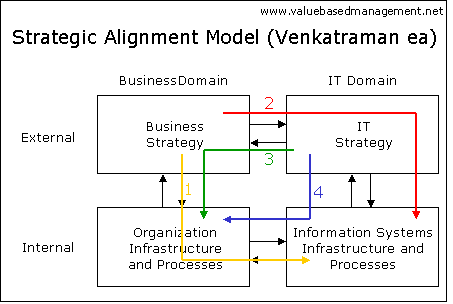
But this is not a new thought, much of my thinking around this topic is summed up in this diagram that dates back to 1993.

Here is the quoted text that explains it (click here for full text):

Venkatraman ea argue in 1993 that the difficulty to realize value from IT investments is firstly due to the lack of alignment between the business and IT strategy of the organizations that are making investments, and secondly due to the lack of a dynamic administrative process to ensure continuous alignment between the business and IT domains.

They describe Four Dominant Alignment Perspectives towards the analytic alignment of Business and IT:

  1. Strategy Execution: this perspective views the business strategy as the driver of both organization design choices and the logic of IS infrastructure (the classic, hierarchical view of strategic management). Top Management is strategy formulator, IS Management is strategy implementer. [Arrow 1]

  2. Technology Potential: this perspective also views the business strategy as the driver, however involves the articulation of an IT strategy to support the chosen business strategy and the corresponding specification of the required IS infrastructure and processes. The top management should provide the technology vision to articulate the logic and choices pertaining to IT strategy that would best support the chosen business strategy, while the role of the IS manager should be that of the technology architect - who efficiently and effectively designs and implements the required IS infrastructure that is consistent with the external component of IT strategy (scope, competences and governance). [Arrow 2]

  3. Competitive Potential: this alignment perspective is concerned with the exploitation of emerging IT capabilities to impact new products and services (i.e., business scope), influence the key attributes of strategy (distinctive competences), as well as develop new forms of relationships (i.e. business governance). Unlike the two previous perspectives that considered business strategy as given (or a constraint for organizational transformation), this perspective allows the modification of business strategy via emerging IT capabilities. The specific role of the top management to make this perspective succeed is that of the business visionary, who articulates how the emerging IT competences and functionality as well as changing governance patterns in the IT marketplace would impact the business strategy. The role of the IS manager, in contrast, is one of the catalyst, who identifies and interprets the trends in the IT environment to assist the business managers to understand the potential opportunities and threats from an IT perspective. [Arrow 3]

  4. Service Level: This alignment perspective focuses on how to build world class IT/IS organization within an organization. In this perspective, the role of business strategy is indirect. This perspective is often viewed as necessary (but not sufficient) to ensure the effective use of IT resources and be responsive to the growing and fast-changing demands of the end-user population. The specific role of the top management to make this perspective succeed is that of the prioritizer, who articulates how best to allocate the scarce resources both within the organization as well as in the IT marketplace (in terms of joint ventures, licensing, minority equity investments, etc.). The role of the IS manager, in contrast, is one of business leadership, with the specific tasks of making the internai business succeed within the operating guidelines from the top management. [Arrow 4]

The idea is to think through where a technology strategy or project starts to how it is implemented. Does it start with a tool, then you look how to leverage it? Does it start with a business or technology need? Or is it tied to the overall strategy? I think each of these has there place, there are times where technology should drive the strategy or where technology should be asked to solve a single problem. BUT that should be balanced by allowing technology to participate in the mission strategy as well.

I blame the CEO. Oops did I say that outloud? If technology is not integrated into your mission and mission team, I blame the CEO. The CEO does not have to be involved in, completely understand or even totally support technology. But the CEO is ultimately responsible for three things: appointing correct IT leadership, giving needed authority to IT staff and providing a reasonable budget. Notice I didn’t say they have to love technology, nor do they need to have cutting edge tools or whatever…

Before I continue my rampage, watch this slideshow about the role of CEO and CIO. This slideshow was the end result of years of work of the IT Director and CEO building a relationship.

I hope the positive approach in that slideshow was better than my short attack paragraph on CEOs, which really wasn’t meant as an attack at all. I have met many CEOs that I like.

The point here is that the IT department can do everything in their power to help meet the mission but until they are aligned within the organization it wont be as effective.

If you enjoyed this, good, because there are 10 more posts coming about the remaining chapters in the book called Managing Technology to meet your Mission. NTEN is also running an AWESOME 2 day online conference! Sign up today.

Thursday, July 23, 2009

Zoo or Jungle? what is your IT alignment?


When you go to the Zoo each of the animals has their area to live in. The zookeepers do everything they can to replicate the animals natural environment, diet and activity in their cages. They provide the best care that they can to keep the animal healthy and happy. The zoo keeper is focused on one exhibit or area at a time. However very few, if any, of the actions that the Zoo Keepers make for each animal actually help the full zoo. You treat each of the animal areas as individual projects.

In the jungle the ecosystem is what keeps it all running. It is no longer enough to only look at the needs of individual animal. Every decision and action has to be weighed against the overall shift in the ecosystem.

When we allow our organizations to grow into silos and then implement the technology solutions for each individual area are we just tending a zoo? So while that technology may help that individual, what did it do for the org or for the full mission?

My boss, Judith Sol Dyess, just posted some similar thoughts about how she just "deleted her strategy" on her blog. I find it very interesting that without strong IT leadership, further exaggearted with a big disconnect between IT and Leadership that the Zoo silos grow. Here is a quote from Judith:

"...one thing stands out. We have moved from projects that benefit the entire org, to department-based work. That’s not to say that Finance or Marketing don’t have valid technology needs, not at all. But this segregation of projects is troubling."

IT Alignment is all about matching your technology strategy to your organizations mission. Too often we get stuck tending the monkeys and loose track of the jungle we are in.

(zoo photo from Flickr mag3737)

Thursday, July 9, 2009

Role of my faith in my work

Some of us may have a type of job where it is hard to bring our faith, beliefs and religion to work. Well that is yet another reason to love where I work, the YMCA. Although our historical roots as an organization with heavy evangelism and bible studies is not as prevalent today as I would like in the Chicago Association, everything we do is still rooted in those beliefs and values. So while I am work I am able to bring all of who I am with me.

However in the last year I have started to notice that when I am talking in my NPTech circles, that I have somehow hid my faith and beliefs. It is almost as if I have allowed myself to focus so much on tech and nonprofit talk that everything else slides to the back. Recently though many things have been pushing me to let my faith shine.

The Religion & Technology Divide is a Guest Post by Paul Lamb on the famous Beth's Blog. This blog talked about disparity between technology and religion. This mirrors my own personal thoughts.

One of the things that I have enjoyed is that my church home, Community Christian Church, has embraced a lot of technology. The leadership and staff of the church have embraced technology within the services, throughout the building and even embracing social media. They see the ability of YouTube to spread the message through hilarious videos (like the one I am in here). Our pastors are all over Twitter and Facebook because they see the value in creating or enforcing relationships.

Anyway, I am rambling, so back to my point (or 2 points to be exact).

Point #1 =How many of us hide part of ourselves or our beliefs because we are afraid?

Afraid to offend someone?
Afraid to not fit in?
Afraid to have our beliefs challenged by others?
Afraid to mix personal and professional?

I think many of us try to treat our lives like the government, where we try to separate Church and State. But even the government cant keep them separate. I am going to be more deliberate about not hiding my faith.

Point #2 - Churches should see that technology is not inherently evil and the NPTech sector should look to help churches find positive ways to leverage it.

All technology seems to have a dark side and can be used in bad ways, but if the harm didnt outweigh the good would it still continue to thrive and grow? Well ok yes, it probably would but... Technology can be used in very positive ways. And isnt the church here to help us live our lives in a way that is pleasing to God? As individuals we are all faced with the moral challenges that technology and the internet provide. If the church hides from these moral challenges, how can they help us? We need the church's support and guidance to navigate these choices.

As far as the NPTech sector goes, how can we ignore the faith based side of the nonpofit world? I think you would be hard pressed to find a more devoted following than those who belong to a church. Why dont we leverage that and collaborate more? And is it just me or is the topic just not talked about?

Final thought

So what is the role of faith in my work? Since my faith and beliefs are a big part of me, then naturally they are going to come with me. They play a large role in every decision I make, every thought I have and every action I take.

Well those are my thoughts, as random as ever, but probably not as humorous as I try sometimes. I dont claim to have all the answers on this topic, nor am I an expert. I would love to be challenged and questioned on this, it helps me think it through.

Photo Credit=kid w/iphone from mastrobiggo on Flickr

Wednesday, June 24, 2009

T-Shirts transform people to heros

Each of you has been issued a t-shirt. You have to wear everyday it while you are working here for the next week. This t-shirt will give you an instant reputation and a free pass to many things. This t-shirt has been worn by many, many groups and individuals before you. The people here in New Orleans know and recognize the t-shirt and they know you are here to help. Wearing that t-shirt you can walk into a restaurant, use the bathroom and leave, and noone will question you. That t-shirt will allow you to walk down some of the most dangerous neighborhoods and people will be kind to you. That t-shirt transforms you into a hero into the eyes of the people here. They will know you are here to serve and pray with them.

This was one of the opening speeches I heard last week when I went with my son's youth mission trip through Community Christian Church in conjunction with EFCA in New Orleans. By the end of the week, I knew that he was serious. The people were so friendly to us, they were willing to talk and pray with us. When we put on those t-shirts and went out as teams, we were no longer individuals, we represented something bigger. It would have been hard for any one of us to make a lasting impact, but as a team unified by a t-shirt we did make an impact.

We were transformed internally when we put on the t-shirts also. While wearing the t-shirts we forgot what was important to us or what we wanted to do and focused on the needs of the group and project. We even slept on floors and showered with frogs. Groups worked on roofs in New Orleans in summer! (95 degrees and humid)

At the end of the week they challenged us to not let our work stop when we took off the t-shirt. They dared us to live everyday as if we were wearing that t-shirt.

And that really made me wonder how far this t-shirt idea could go. A logo t-shirt transforms a group of people from a crowded hike into a walk-a-thon curing cancer or a group of kids kicking each other into a soccer game. People bonding together around a cause, idea, goal or team get transformed when they have a badge they can wear that tells others what they believe in or what they are doing.

However this transformation is not because the t-shirts are magic. It is because they have a symbol to rally behind. YMCAs are great at promotions like giving out t-shirts, water bottles, pencils, etc. And people seem to like wearing our "gear." But that t-shirt does not transform the person. The transformation comes only if that t-shirt is tied to an action, a cause, a team or somehow letting that be a part of your organization. Giving the t-shirt is not as important as inviting them into your team.

Transferring this to the web may not be as hard as you think. I think that adding the causes application or becoming a fan of an org on Facebook can be similar to wearing a t-shirt. You have some cool "gear" to display on your profile. But just like that promotional t-shirt, just getting a fan isnt enough, you have to get them engaged and invite them into your team. DONT give them the t-shirt to just wear as an advertisement, let them crave the t-shirt because they are so involved in your team.

On a side note, I must say that anyone that discounts the importance of teens in making a difference should go with us next year. These teens worked harder, sacrificied more and prayed in a way that I could never imagine. Teens are not the future changemakers, they are todays changemakers.

I am trying to figure out an "online t-shirt" that people can earn and wear online to work on behalf of the YMCA or to be our spokesperson. hmmmm......

Monday, June 8, 2009

Represent the Brand - Keynote presentation

One of the biggest challenges that a YMCA may have is that each individual staff person holds the keys to our success (or challenges).

For example, our camp staff have the opportunity to impact a kid's life possibly forever. The relationship between camper and counselor could form an impression that lasts a lifetime. We can either win over a supporter or make them run away. As if it isnt enough to worry about the experience the camper has, we also have to help the staff have a good experience so that they come back also.

So here is the opening set of sketches that I did for the YMCA of Metro Day Camp staff. The whole idea is that when you need to be purposeful separating your professional and personal behavior. Also when you are representating the brand you have to be a role model (online & offline). A secondary thought that came out was "Camp memories may last a lifetime, but the internet remembers everything forever, so act accordingly."


Tuesday, May 26, 2009

Is LinkedIn a weak spot in your social networking chain?


So a while back Beth Kanter asked me to write a "resource rich" post about how to use LinkedIn and I have been trying to come up with something very clever to say. But I just realized that I dont need clever when direct and simple will work better.

We are all spending time building our personal networks and at work we may spend time building our organization's network, but are we spending anytime growing our own career and brand as many like to call it (like Dan Schwabel in Me 2.0 or many other bloggers)?

LinkedIn is a professional network with a low entry point of time commitment, clean interface with a clear purpose of helping you be successful in your career or business.


Lets face it, at one point or another all of us will be looking for a job, looking to hire someone or trying to make a business connection, so why wait until the need smacks you in the face, get LinkedIn. So build your professional network now.

Here are some creative ways I would suggest using LinkedIn.
  • Install the Slideshare or Google presentation app and create a powerpoint that shows who you are
  • Install the box.net files and upload some samples of work you are allowed to share
  • Post your volunteer experience
  • Keep in touch with your orgs staff alumni (create a group)
  • Make sure someone checks your company's profile to add details and information about your organization

And beyond that, if you work for a nonprofit, job recruiting can be even tougher. So you need to take advantage of every opportunity to share who works at your organization and why they love it. You should encourage all of your staff at your nonprofit to join LinkedIn in my opinion. Many people have a Facebook or other personal socialnetworking page, but how many have something to represent themselves professionally ? Do your staff even understand the difference? As nonprofits dont we have some sort of duty to equip our staff to grow their career, even if they leave our organization? (see my powerpoint on this)

OK, so that was too many random thoughts, here is the direct portion followed by some AWESOME resources:

Dan Schwabel in the book Me 2.0 offers this advice for Linked In.
1. Craft your profile (my thoughts=Spend time filling in all areas and think through how you want to be seen. Pick a focus for who you are, dont try to list everything.)
2. Start and expand your network (my thoughts= use the tools to find colleagues from past jobs, import your contacts from your email, join some groups, look at your friends list of contacts to recruit more. Then spend time setting up groups and organize your contacts. Then everytime you go to an event or meet people, connect with them on LinkedIn.)
3. Control your Google results
4. Ask for Advice (my thoughts= Dont just ask for advice, be a giver, answer some questions.)
5. Get Recommendations (my thoughts= Recommed other people. Dont just spam and ask everyone to recommend you, ask people who will take the time to post a well written, thoughtful recommendation. And maybe seek out those people who are influential.)
6. Search Jobs

Here are some great resources:
What I see missing from all of these is how to use this as a nonprofit to fight for a cause, but I think that is the point here. We have to balance which tools we use to promote ourselves, our organization and our cause. Maybe this isnt the best place to promote a cause, but it might be good to find AWESOME staff or stay connected with other professionals as individuals and orgs.