Showing posts with label facebook. Show all posts

Monday, July 8, 2013

YMCA of Metro Chicago Facebook Resources and Case Study

This is a post I created back when I was at the YMCA of Metro Chicago, but thought I would re-share it here.

How do you get 50 authors prepared to manage 15 Facebook pages in less than 2 months with a team of 4 people? The YMCA of Metro Chicago faced just this challenge in the summer of 2010. There was a desire to get a presence established on Facebook in order to connect with our communities in new ways and do it quickly!

Our bigger challenge was managing the pages once they were launched. This case study will walk through the process we followed to get the pages launched and equipped the authors to manage them.

Below is a short summary or for a more visual representation view our YMCA of Metro Chicago Facebook Case Study Presentation.


Our Challenge Our members and communities connect with their individual center and want information from them. But there are numerous obstacles in allowing our membership centers to take primary responsibility for their own pages:
  • Membership center staff already fill numerous roles and have limited time to dedicate to new projects
  • Experience with social media and online communities is limited in depth beyond personal experience
  • Staff already struggle to get content created for our websites, newsletters and email communications
  • Limited full-time staff at some centers and limited resources to pay part-time staff
Our Metro office had challenges of its own to overcome:
  • Limited capacity to manage page for all centers, need to equip authors to create sustainability
  • Brand management and YMCA information needed to be monitored and consistent across our channels
  • How can we provide enough support to make sure the center pages are successful and what do we do if they aren’t
  • Manage risk, possible negative interactions and uphold character values
Our Strategy The key to our success was the readiness of the authors, not the mechanics of the page. So with seven weeks to work with we decided the key was to establish staggered deadlines for the authors to meet and a focused one day boot camp.
Due with application Due at Kickoff Due before Boot Camp Due before launch
  • Create Flickr acct
  • Completed Application
  • Create Facebook profile
  • Attend kickoff
  • Communication samples
  • 15 photos
  • Review Facebook privacy
  • Write 2 status updates
  • Marketing calendar
  • Fill in Facebook page
  • October Mktg. calendar
  • Document comment reply process
  • Sign Author Ack.
While the authors were busy preparing their materials; Marketing and IT collaborated to get the Facebook pages configured and designed for all of the centers. Our approach was to get all of the pages setup identically to a point where they were ready to launch without involvement of the centers. We created guidelines of what could be edited and what should be left standard.

We wanted our centers to focus on the content, not the structure of the page. However we did give them the long term freedom to make changes once they were ready to support it themselves. This structured approach allowed us to gauge the readiness and commitment of each member center even before launch. It also helped set expectations for our Boot Camp.

Our Materials Once the authors were trained and the pages launched; the centers have primary responsibility for managing the page with limited support from Marketing and IT. So we needed to be very purposeful in providing them with the appropriate resources. We provided them with:
  • Social Media Author Acknowledgement – In addition to getting their commitment to represent the YMCA appropriately, we provided clear expectations of the role
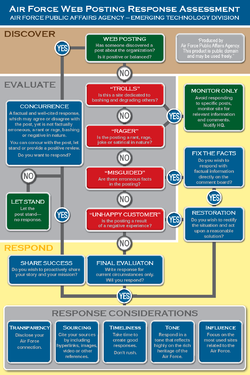
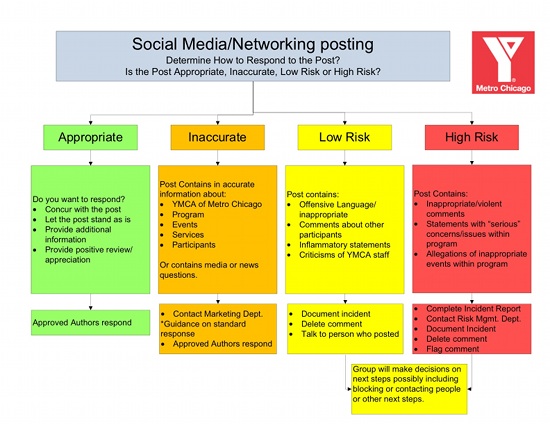
  • Comment Escalation Resources – we shared the Air Force Blog Response Chart along with a Comment Escalation Flow Chart to clearly identify steps in replying
  • Content Tips –Strategies for quality content and how to represent the brand
  • Page Administration Guidelines – Parts of the pages that can be edited and disallowed Facebook Applications
  • Marketing Calendar Template – Table structure to assist in thinking about how to post content across all communications and marketing
  • Links to articles on privacy – Shared links on updating your personal Facebook profile privacy settings
Most of these resources are included in the Facebook Manual below:


Our Outcomes Aug 23, 2010 we launched our pages, before the end of the day we had our 25 fans to secure our vanity URLS and our authors were posting welcome messages. Over the next couple weeks our centers worked to promote the page to all of their staff to build up some initial fans. We placed the “find us on Facebook” button on all of our website homepages.

By the end of August 2010, we had over 1100 fans across the pages, 116 wall posts by authors, almost 1500 unique page views and some great early engagement. In October 2010 we began our mass promotion of the pages to our members through emails, newsletters, program brochures and more. As of Nov 2, 2010 we were up to 2,285 fans across 15 pages, with 2,618 unique views and 396 comments\likes on our content for October 2010.

Our authors have done a fantastic job moderating comments and posting content!

Monday, August 27, 2012

Prepare your staff (Give staff a voice! Part 5 of 10)

Imagine sending one of your staff members to a press conference without any notice, without telling them what to talk about. Just train them about what a press conference is and how it works. Then hope for the best.

Yeah, it's like that.

It is easy to memorize a speech and post prepared content. It is not easy to manage a community and reply to the tough questions.

We can spend as much time as we want training people how to use social media, how it works, how to create good content, but do we prepare them for the questions, flashing cameras, criticisms and onslaught of a press conference?

In social media you have to expect some unhappy people, some trolls (people who like to complain and start fights) and some mistakes.  Do we do enough to make our staff ready?

In our trainings we focused on what our staff were already comfortable with. We started with talking about what people call about the most. We then talked about what are the most common and most difficult questions they get in their onsite comment boxes.  We asked them to think through their replies that they use in person. Then we helped translate those to an online situation.

The big trick is deciding when to reply, how much to say and knowing when to take it offline.

One big thing we emphasized was to not to jump to deleting a post or banning a user. Can you say backfire?

Our training was two parts.
Motivation - First we used the Air Force blog response chart to talk about how to understand WHY people are commenting. Because understanding motivation is key to the reply.
Respond - Then we had a comment response chart of our own to help them to decide if and how to reply\act.


That was our idea of how to prepare them.

Monday, November 8, 2010

YMCA of Metro Chicago shares Facebook Resources

Detour again... So I have been too busy with silly videos and work to keep going with the #netnon posts, but I do promise to get back to them next week. But this week I have to share something from the IT team at the YMCA of Metro Chicago (my job).

We recently launched 15 Facebook pages for our YMCA membership centers. And on our new YMCA of  Chicago IT blog we have shared a PowerPoint case study, which is cool, but...

Even cooler is the Facebook Manual! No sorry, it does not teach you how to use Facebook. Rather this is what we created to help guide our authors.  Notice, I said guide our authors, which is slightly different than just rules.

Anyway, here is the link, go check it out NOW! 

Thursday, July 29, 2010

Facebook Metrics! Measure from the start

August 23, 2010 is the planned date that the YMCA of Metro Chicago will be launching about 20 Facebook pages, one for each of our membership centers.  In about 2 months time we have created a process to build the pages, train the authors, drive the strategy and make it happen.  But we recognize that we will need to measure our progress. So this is when I turned to Beth Kanter for advice, well her blog, not her personally.

Spreadsheet aerobics is a blog post from Beth that talks about how to measure your Facebook work and experiments. I took her advice, but I am doing it one step at a time. 

We have created a set of trainings, materials and steps to rapidly deploy our social media sites.  Our first effort is Facebook for our membership centers. Our first goal is to establish our presence and provide the foundation to begin to connect with our members.  We want to be where our communities are and communicate with them they want to.

Once we have the basics working, authors trained and a presence established we will work to equip our YMCA staff as authors to begin to create engagement with purpose. But we have to start somewhere, which for us will be creating the presence, training our staff and just getting it rolling!

In that effort, we will just be tracking the basic stats straight from Facebook Insights.  Each our Facebook page administrators will download the interactions stats into Excel and send it to us.  We will then copy those numbers straight into this report format.  Our hope is to be able to show the correlation between those actively interacting on their page with the increase in participation of fans.

Anyway, here is spreadsheet report, based on concepts from Beth Kanter.